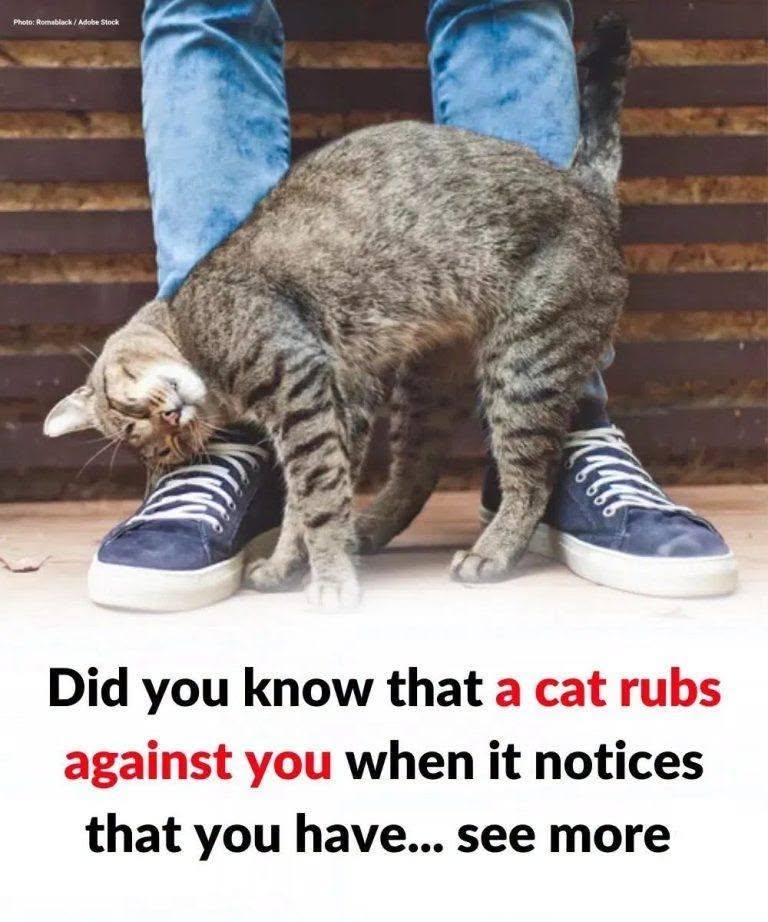
Why a Cat Rubs Against You: What Your Cat Is Really Trying to Tell You
Have you ever walked into a room and had your cat immediately come over, circle your legs, and rub its head or body against you?
It can look like a simple display of affection.
And often, it is.
But when your cat rubs against you, there may be several things happening at once. Your cat could be greeting you, leaving its scent, asking for attention, feeling comfortable around you, or simply communicating in a way that is completely natural to cats.
Understanding this behavior can tell you a lot about how your cat sees you.
1. Your Cat Is Saying Hello
One of the simplest explanations is that your cat is greeting you.
Cats often rub against people they recognize and feel comfortable with.
You may notice this especially when you return home after being away for a while. Your cat may walk toward you, raise its tail, and rub against your legs.
It’s essentially a feline greeting.
Your cat has noticed your arrival and is acknowledging you.
2. Your Cat Is Leaving Its Scent
Cats rely heavily on scent to understand their surroundings.
They have scent glands around their cheeks, forehead, chin, and other parts of their bodies.
When your cat rubs its face or body against you, it can leave some of its scent behind.
This doesn’t mean your cat is literally “claiming” you in the dramatic way people sometimes describe online.
Rather, scent is an important part of how cats create familiarity and recognize members of their social environment.
Your scent and your cat’s scent become associated with a familiar, safe environment.
3. Your Cat Trusts You
A cat generally won’t repeatedly rub against someone it considers threatening.
If your cat approaches you voluntarily, presses its head or body against you, and remains relaxed, that’s usually a good sign.
Your cat is comfortable enough to enter your personal space.
For an animal that naturally values control over its environment, choosing to come close can be meaningful.
Your cat may be telling you:
“I feel safe around you.”
4. Your Cat Wants Attention
Sometimes the message is very straightforward.
Your cat wants you to notice it.
Maybe it wants petting.
Maybe it wants you to talk to it.
Maybe it wants to sit beside you.
Or perhaps it simply wants a little interaction.
If your cat rubs against you and then looks toward you, meows, or walks toward another area, pay attention to what happens next.
It may be trying to lead you somewhere.
And yes, sometimes that place is the food bowl.
5. Your Cat May Be Asking for Food
Cats are experts at learning routines.
If you usually feed your cat at a particular time, your cat probably knows it.
A cat that starts rubbing against your legs around mealtime may have a very specific message:
“It’s time.”
Some cats will combine rubbing with meowing, staring at their owner, walking toward the kitchen, or repeatedly checking their food bowl.
You don’t need to wonder what that means.
Your cat has probably already submitted its dinner request.
6. Your Cat May Be Happy to See You
Cats are often described as independent, but that doesn’t mean they don’t form strong social bonds.
Many cats recognize their owners and develop routines around them.
If your cat regularly greets you by rubbing against you, purring, following you around, or sitting nearby, these behaviors may indicate that your presence is familiar and comforting.
Cats show affection differently from dogs.
They don’t always run toward you enthusiastically.
Sometimes their version of affection is simply choosing to be close.
7. Head Rubbing Can Be Especially Meaningful
There is a difference between casually brushing against your legs and deliberately pressing the head or face against you.
Cats have scent glands around their cheeks and forehead.
When a cat gently presses or rubs its head against you, this behavior is often called head bunting.
It’s generally associated with friendly social interaction.
If your cat does this voluntarily and appears relaxed, it’s usually a positive behavior.
It can be one of the ways cats communicate familiarity and social trust.
8. Your Cat May Be Creating a Familiar Social Scent
Cats don’t experience the world exactly as humans do.
Scent plays a major role in their perception of their environment.
In multi-cat households, cats that get along may rub against one another and share familiar scents.
When your cat rubs against you, it can be part of this broader social behavior.
You’re becoming part of an environment that smells familiar and safe to your cat.
This is one reason cats may also rub against furniture, doorways, blankets, and other objects.
9. Your Cat May Be Trying to Communicate Something
Body language matters.
Rubbing by itself is usually harmless and friendly, but you should look at the entire picture.
A relaxed cat may have:
A loose body
Ears in a natural position
A relaxed or upright tail
Soft eyes
Normal breathing
Comfortable movement
If your cat suddenly becomes unusually clingy or repeatedly rubs against you while showing other unusual behaviors, pay attention.
Changes in behavior can sometimes signal stress, discomfort, or illness.
The behavior itself isn’t necessarily a problem.
The change from your cat’s normal behavior is what matters.
10. Why Does Your Cat Rub Against Your Legs?
Leg rubbing is particularly common because your legs are easy for a cat to reach.
Your cat can walk around you while rubbing its face and body against your legs.
It may happen when you enter a room, when you come home, or when your cat expects food.
Just be careful.
Cats don’t always understand that humans can trip over them.
If your cat repeatedly weaves between your feet, slow down when walking to avoid accidentally stepping on its paws.
11. Why Does Your Cat Rub Against You and Then Walk Away?
This can be confusing.
Your cat may rub against you enthusiastically and then suddenly walk away as if you don’t exist.
Don’t take it personally.
Cats often communicate in short social interactions.
Your cat may simply have said hello and decided that the conversation is over.
It might then go sleep somewhere, investigate a noise, look out a window, or groom itself.
Affection doesn’t necessarily mean your cat wants to sit on your lap for the next hour.
Cats often like connection on their own terms.
12. Why Does Your Cat Rub Against You More Than Other People?
Your cat may simply have a stronger relationship with you.
Maybe you’re the person who feeds it.
Maybe you spend the most time at home.
Maybe you play with it.
Maybe you respect its boundaries.
Or perhaps your personality and behavior make your cat feel particularly comfortable.
Cats can develop individual preferences.
If your cat consistently chooses you, that’s something special.
13. What If Your Cat Rubs Against You and Then Bites?
This can happen.
A cat may enjoy interaction but become overstimulated.
Watch for warning signs such as a rapidly moving or twitching tail, flattened ears, tense body language, dilated pupils, or sudden changes in posture.
Some cats also become irritated if they’re petted for too long.
The safest approach is to respect your cat’s signals.
If your cat walks away, let it go.
If it becomes tense, stop petting.
Learning when to stop can actually strengthen your cat’s trust in you.
14. Should You Rub Back?
If your cat approaches you comfortably, gentle interaction is usually fine.
Many cats enjoy being stroked around the cheeks, chin, or head.
But every cat is different.
Some love being touched.
Others prefer sitting beside you without being handled.
Let your cat guide the interaction.
If it leans into your hand, relaxes, or remains close, that’s generally a good sign.
If it pulls away, becomes tense, or tries to leave, give it space.
Respecting boundaries is one of the best ways to build trust.
When Rubbing Could Mean Something Is Wrong
Most rubbing against you is normal social behavior.
However, there is an important distinction between ordinary rubbing and excessive rubbing or scratching.
If your cat suddenly starts rubbing its face against objects much more than usual, scratching constantly, losing fur, developing red skin, or showing signs of irritation, something may be wrong.
Possible causes can include skin irritation, parasites, allergies, or other medical problems.
Similarly, if your cat suddenly becomes extremely clingy, withdrawn, stops eating, changes its litter-box habits, or behaves very differently from normal, don’t assume it’s simply seeking affection.
A veterinarian can help determine whether there is an underlying problem.
Your Cat May Be Saying More Than You Realize
Cats communicate without words.
They use their ears.
Their tails.
Their eyes.
Their posture.
Their voices.
Their scent.
And, of course, physical contact.
When your cat walks over and gently rubs against you, it may be communicating several things at once:
“I know you.”
“You’re familiar.”
“I feel comfortable here.”
“Pay attention to me.”
And sometimes:
“Where’s my dinner?”
The exact meaning depends on the situation and your individual cat.
But if your cat regularly chooses to approach you, rub against you, and remain close, you can generally take it as a positive sign.
The Beautiful Thing About Cats
Cats don’t usually give affection exactly the way humans expect.
They don’t always greet us with excitement.
They don’t always want to be held.
They may ignore us for hours and then suddenly appear beside us.
But when a cat chooses to approach you, rub its face against you, purr beside you, or quietly sit in the same room, those small gestures can be meaningful.
Your cat may not be able to tell you in words that it trusts you.
Instead, it communicates through behavior.
So the next time your cat walks over and gently rubs against your legs, don’t just step around it and continue with your day.
Pause for a moment.
Give it a gentle scratch if it enjoys that.
Say hello.
Because to your cat, that tiny interaction may be part of a much bigger relationship.
Your cat isn’t just rubbing against you.
It’s communicating with you in the language it knows best.