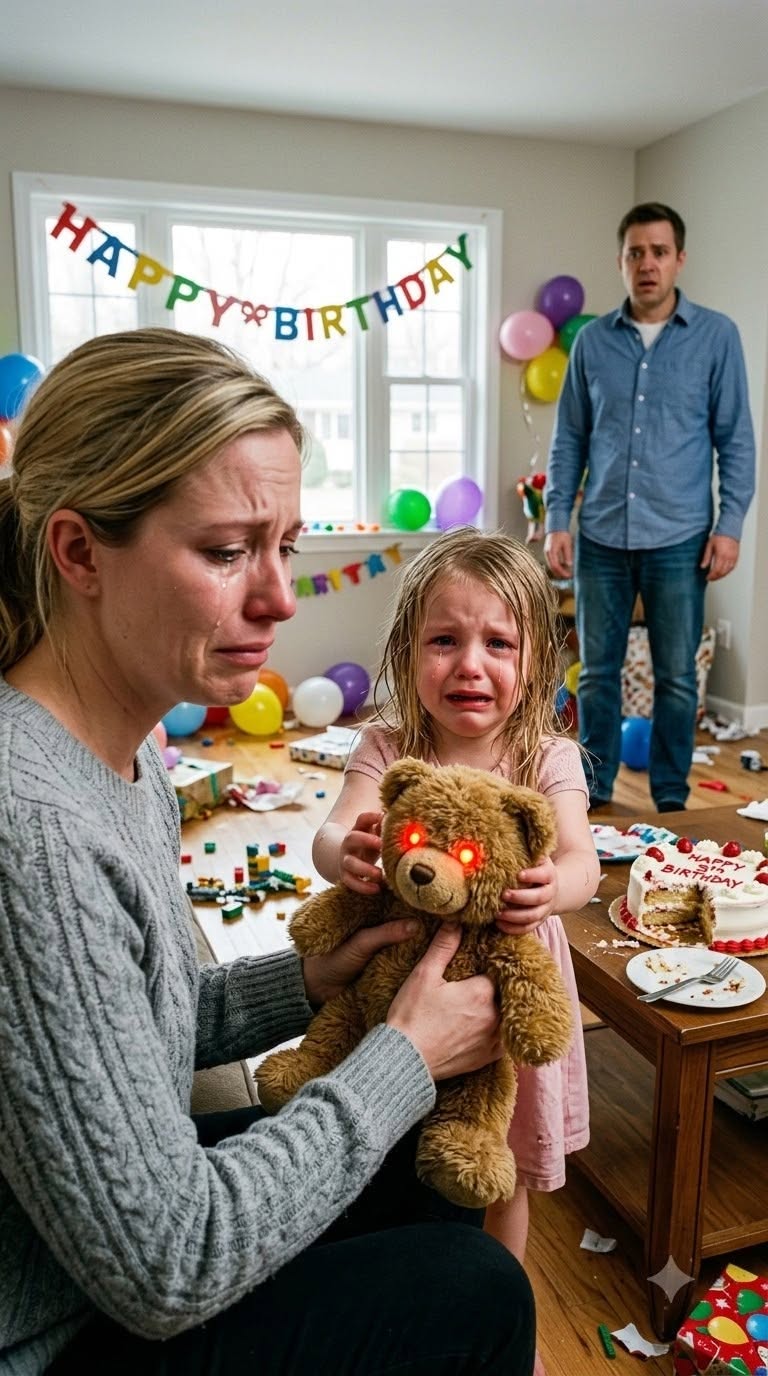
My Six-Year-Old Daughter Asked, “Mommy… What Is Wrong With Its Eye?”
For Lily’s sixth birthday, my husband’s parents sent her a soft brown teddy bear wrapped in shimmering gold paper and finished with a satin ribbon.
The moment she spotted the package, she squealed with excitement.
“Grandma and Grandpa remembered!” she cried, skipping barefoot across the living room.
I smiled, although a cold knot formed in my stomach. David hadn’t spoken to his parents in almost eight months. Their last fight had been over boundaries, unannounced visits, and Eleanor constantly whispering to Lily that “Mommy is unstable” every time I set a rule.
Still, it was my daughter’s birthday. I refused to let old family drama ruin her special day.
“Go ahead,” I told her. “Open it.”
She ripped away the wrapping paper, lifted out the teddy bear, and hugged it tightly. It was fluffy, chocolate brown, and ridiculously adorable.
Then she suddenly froze.
Her smile disappeared.
She slowly pulled the bear away from her chest and stared at its face.
“Mommy…”
Her voice was barely a whisper.
“What is wrong with its eye?”
I looked at the teddy bear.
At first, I saw nothing unusual.
Then I noticed it.
One of the bear’s eyes looked slightly different from the other. It wasn’t the shiny plastic eye I expected. It appeared to be a tiny dark lens, almost perfectly hidden inside the stitching.
My stomach dropped.
“Give me the bear, sweetheart.”
Lily handed it to me.
I turned it over, examining the seams. My hands were suddenly shaking.
“David,” I called.
He walked into the room, still carrying a birthday plate from the kitchen.
“What’s wrong?”
I held up the bear.
He stared at it for several seconds.
Then his expression changed.
“Where did they get this?”
“I don’t know.”
David took out his phone and called his father.
No answer.
He called again.
Nothing.
I didn’t want to jump to conclusions. I didn’t want to frighten Lily. And I certainly didn’t want to accuse anyone without knowing what we were looking at.
So I did the one thing that felt reasonable.
I stopped touching the bear.
I placed it carefully on the table, moved Lily into another room, and contacted the police.
An officer arrived later that afternoon. After examining the toy, he told us they needed to take it for further testing.
The next three days were filled with questions.
Where had the bear come from?
Who had purchased it?
Had anyone entered our home recently?
Had Lily ever taken it outside?
I kept replaying the moment in my mind—the way my daughter had hugged that innocent-looking teddy bear, completely unaware that something about it might have been terribly wrong.
Then, three days later, a police car pulled up outside my in-laws’ house.
David and I watched from our own car as two officers approached their front porch.
I felt sick.
Because whatever was hidden inside that teddy bear wasn’t a family misunderstanding anymore.
It was evidence.
And suddenly, the argument about boundaries from eight months earlier seemed very different.
Sometimes a warning doesn’t arrive as a knock on the door.
Sometimes it arrives wrapped in gold paper, tied with a ribbon, and placed into the arms of a child.
And sometimes, the smallest detail—the tiniest “eye”—is enough to make you realize that you need to stop asking why would they do this?
…and start asking “How long has this been happening?”