I Spent My Children’s Inheritance on a Luxury Car After Their Mother’s Funeral
I am 85 years old, and three months ago, I buried the woman I had loved for nearly six decades.
My wife, Margaret, was the center of my world.
For 58 years, she was the first person I saw every morning and the last person I spoke to every night.
When she died, the house became unbearably quiet.
Her favorite chair was still beside the window.
Her slippers were still beside the bed.
Her coffee mug was still sitting in the kitchen cabinet.
Everywhere I looked, I saw her.
And then came the funeral.
I expected grief.
I expected tears.
What I didn’t expect was my children arguing about money before their mother’s coffin had even been lowered into the ground.
My oldest son, Daniel, asked me about the will.
At the cemetery.
My daughter, Rebecca, wasn’t much better.
She whispered, “Dad, we should probably discuss the estate soon.”
I stared at both of them.
“My wife isn’t even buried yet.”
Daniel shrugged.
“We’re just trying to understand what happens next.”
What happened next was that I stopped telling them anything.
Over the following weeks, they became increasingly interested in my finances.
How much was in the savings account?
What properties did I own?
Had I updated my will?
Was the house going to be sold?
They never asked the questions that mattered.
“Dad, are you eating?”
“Are you sleeping?”
“Do you need someone to stay with you?”
Instead, they talked about what their mother had left behind.
One evening, I sat alone in Margaret’s kitchen and made a decision.
I opened the latest copy of my estate documents.
Then I called my financial adviser.
“I want to buy something.”
He was surprised.
“What?”
“A car.”
“A new car?”
“Yes.”
“A luxury car?”
I smiled.
“Yes.”
I’d spent my entire life saving money.
I worked.
I raised children.
I paid mortgages.
I repaired the same old car until the mechanic finally told me it was time to let it go.
Margaret and I had always dreamed about traveling after retirement.
We never did.
There was always another bill.
Another responsibility.
Another reason to wait.
Now there was no Margaret.
But there was still me.
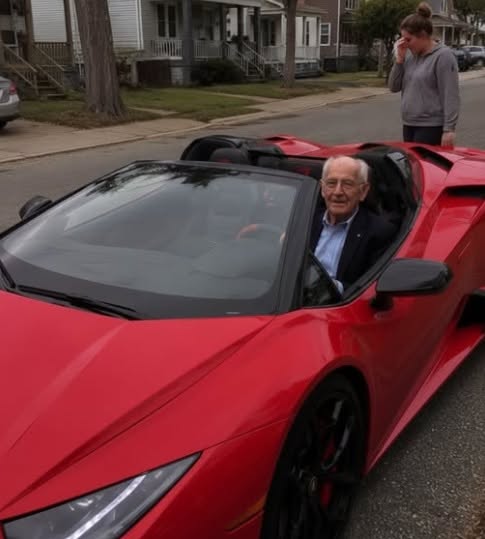
So I bought the car.
It was beautiful.
Comfortable.
Completely unnecessary.
And for the first time in months, I felt something I hadn’t felt since my wife died.
Excitement.
I took it on a long drive the following weekend.
I played Margaret’s favorite music.
I stopped at a little restaurant we used to visit when we were younger.
And for a few hours, I wasn’t an old widower sitting in an empty house.
I was simply a man remembering his life.
My children found out.
They were furious.
Daniel came to my house with Rebecca.
“You spent our inheritance on a car?”
I looked at them.
“Your inheritance?”
Rebecca shook her head.
“Dad, that’s money Mom and you saved for us.”
“No,” I said.
“It was money your mother and I earned during our lifetime.”
Daniel became angry.
“You promised we’d be taken care of.”
“I promised you many things when you were children.”
I paused.
“But I never promised you my money while I was still alive.”
Then I placed an envelope on the table.
The funeral director’s envelope.
They looked at me.
“What is that?”
I opened it.
Inside was the final invoice from their mother’s funeral.
And beneath it was a handwritten note.
Margaret had written it months before she died.
She had known she was sick.
She had known I would struggle after she was gone.
Her note said:
“Don’t spend the rest of your life saving for people who are waiting for you to die. You and I worked hard for this life. If I’m gone, please live some of it for yourself.”
My children read the note in silence.
I told them something I’d been afraid to say.
“I didn’t buy the car to punish you.”
“I bought it because your mother reminded me that I’m still alive.”
Daniel sat down.
Rebecca started crying.
For the first time since the funeral, neither of them mentioned money.
They asked about their mother.
They asked what she had been like during her final weeks.
They asked what she had wanted for them.
And I answered every question.
We talked until midnight.
The car didn’t destroy our family.
The inheritance hadn’t even been the real issue.
The real problem was that my children had started treating my death like the beginning of their financial lives.
They had forgotten that I was still here.
And perhaps I had forgotten something too.
I had spent so many years being a husband and father that I had forgotten how to simply be myself.
So I kept the car.
I kept Margaret’s note.
And I changed my will.
Not because I hated my children.
Because I wanted them to understand something important:
An inheritance is a gift—not an entitlement.
And while I’m still here, I intend to spend my remaining years living, remembering my wife, and enjoying the life we worked so hard to build.
The money can wait.
Life can’t.