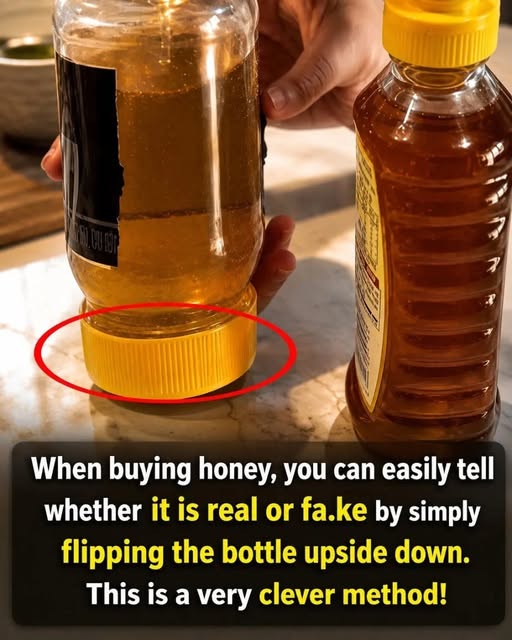
🍯 Think You’re Buying Real Honey? Here’s How to Tell What’s Actually in the Jar
Honey has been treasured for centuries—not only for its naturally sweet flavor, but also because many people appreciate it as a simple, minimally processed food.
But when you pick up a jar labeled “pure honey,” how can you know what you’re really buying?
With so many products on store shelves, it’s easy to assume that every bottle contains nothing but honey.
The reality can be more complicated.
🐝 Start With the Label
The first thing to check is the ingredient list.
If you’re looking for pure honey, the ingredient list should ideally contain only honey.
Be cautious when you see added sweeteners, syrups, flavorings, or other ingredients.
Also pay attention to vague wording such as “honey blend,” which can indicate that the product contains honey mixed with other sweeteners.
🔍 Don’t Rely on Viral Home Tests
You’ve probably seen online claims that you can test honey by dropping it into water, lighting it with a match, or placing it on your thumb.
These tests are often presented as foolproof ways to identify “fake” honey.
They’re not.
How honey behaves can vary naturally depending on its moisture content, temperature, floral source, and processing. A home experiment can’t reliably determine whether a product has been adulterated.
So don’t throw away a perfectly good jar simply because it fails a viral internet test.
🍯 Crystallization Doesn’t Mean It’s Fake
One of the biggest misconceptions about honey is that real honey should always remain perfectly liquid.
In reality, natural honey can crystallize.
Some varieties crystallize quickly, while others remain liquid for much longer.
The appearance of tiny crystals doesn’t automatically mean the honey has gone bad—or that it’s fake.
If you prefer it liquid, gently warming the container can soften the crystals.
🌼 Look for More Information About Its Source
A trustworthy producer may provide information about where the honey was harvested, the floral source, the beekeeper, or the region where it originated.
Local honey producers and beekeepers can sometimes provide much more transparency about their products than anonymous bulk products.
That doesn’t mean an unfamiliar brand is automatically dishonest—but more information can make it easier to make an informed choice.
🏷️ Price Can Be a Clue—but Not Proof
Extremely cheap honey may deserve a closer look, particularly when the price seems unusually low compared with other honey products.
However, price alone cannot prove authenticity.
Expensive honey isn’t automatically pure, and inexpensive honey isn’t automatically fake.
The label, ingredients, sourcing information, and reputation of the producer are more useful clues.
🧪 Want Real Certainty?
If you need to know whether honey has been adulterated, laboratory testing is far more reliable than kitchen tricks.
Professional testing can analyze the composition of honey and identify certain forms of adulteration that aren’t visible to the naked eye.
For everyday shoppers, however, the simplest approach is often the best:
✅ Check the ingredient list
✅ Look for clear sourcing information
✅ Buy from reputable producers
✅ Don’t assume crystallization means the honey is fake
✅ Be skeptical of viral “one-minute” authenticity tests
🍯 The Bottom Line
Real honey doesn’t have to look perfect.
It can crystallize. Its color can vary. Its flavor can change depending on the flowers visited by the bees.
Instead of judging a jar by one viral trick, take a closer look at what the label says, where the honey comes from, and who produced it.
Sometimes the most reliable way to know what’s in your food isn’t a mysterious home experiment.
It’s simply knowing what you’re buying. 🐝🌿