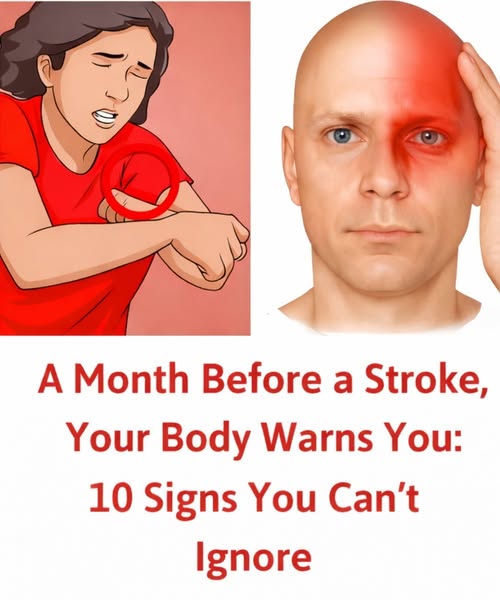
A Month Before a Stroke, Your Body May Send Warning Signals: 10 Signs You Should Never Ignore ⚠️
A stroke can happen suddenly, but some people experience warning symptoms before a major event occurs. These symptoms can sometimes be caused by a TIA (transient ischemic attack), often called a “mini-stroke,” which is a medical emergency and an important warning that a stroke may follow.
The difficult part is that these warning signs can be brief, mild, or easy to dismiss.
That’s why knowing what to look for matters. ❤️
1. Sudden Numbness or Weakness
One of the most important warning signs is sudden weakness or numbness, particularly on one side of the body.
You might notice it in your face, arm, or leg.
If someone suddenly cannot raise both arms evenly or one side of their face droops, don’t wait to see whether it improves.
2. Trouble Speaking or Understanding
Suddenly struggling to find words, speaking unclearly, or having difficulty understanding what someone is saying can be a serious warning sign.
Even if the problem disappears after a few minutes, it should not be ignored.
3. Sudden Vision Changes 👁️
Temporary or sudden loss of vision in one or both eyes, double vision, or unusual blurriness can sometimes occur before a stroke.
Because many eye problems have similar symptoms, sudden vision changes deserve prompt medical attention.
4. Sudden Dizziness or Loss of Balance
An unexpected feeling that the room is spinning, difficulty walking, or suddenly losing coordination can be associated with neurological problems, including stroke.
Especially concerning is dizziness that appears suddenly alongside other warning signs.
5. A Sudden, Severe Headache
A sudden headache that is unusually intense or different from headaches you’ve experienced before should never be casually dismissed.
A severe headache accompanied by vomiting, confusion, weakness, vision problems, or loss of consciousness requires emergency evaluation.
6. Confusion or Sudden Memory Problems
Someone may suddenly seem confused, have trouble answering simple questions, become disoriented, or struggle to understand what is happening around them.
A sudden change in mental function can be a medical emergency.
7. Difficulty Walking
Suddenly stumbling, drifting to one side, or being unable to walk normally can indicate a neurological problem.
Don’t assume it is simply fatigue or getting older when the change happens abruptly.
8. Unexplained Loss of Coordination
Difficulty holding objects, sudden clumsiness, or problems performing familiar movements can sometimes signal a problem affecting the brain.
A new, unexplained change in coordination deserves attention.
9. Sudden Difficulty Swallowing
Problems swallowing that appear suddenly, particularly when accompanied by weakness, speech difficulties, or facial drooping, can be a warning sign.
This is not something to simply “wait out.”
10. Symptoms That Come and Go ⏳
Perhaps the most dangerous mistake is assuming that a symptom is harmless simply because it disappears.
A TIA can cause stroke-like symptoms that resolve within minutes or hours. Even when the person feels completely normal again, urgent medical assessment is important.
Remember FAST 🚨
If you suspect a stroke, remember:
F — Face: Is one side of the face drooping?
A — Arms: Is one arm weak or numb?
S — Speech: Is speech strange, slurred, or difficult to understand?
T — Time: Call emergency medical services immediately.
Don’t drive the person yourself if emergency medical services are available. Note the time the symptoms began, because that information can be extremely important to doctors.
One Important Reminder
There isn’t a reliable rule that says a stroke will always warn you one month beforehand. Some people have warning symptoms, while others experience a stroke without any obvious advance notice.
The safest approach is simple:
Sudden neurological symptoms are an emergency—even if they disappear.
Recognizing the signs could make the difference between waiting and getting potentially lifesaving treatment in time. ❤️