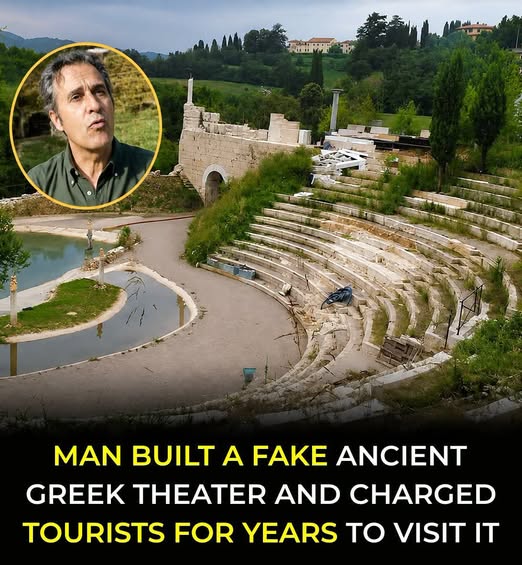
🏛️😲 The “Ancient” Greek Theater That Wasn’t Ancient at All
Imagine paying €40 to walk through what you believe is a centuries-old archaeological discovery—only to learn that the ruins may have been created in modern times.
That is the extraordinary story surrounding a site near Vicenza, Italy, where Franco Malosso reportedly claimed to have discovered the remains of an ancient Greek-style theater after a landslide in 2005.
For years, visitors reportedly arrived believing they were stepping into a piece of history. 🏛️👀
🏺 A Remarkable “Discovery”
According to reports, the site eventually opened to tourists, with admission reportedly costing as much as €40. Private tours could allegedly cost hundreds of euros more.
The setting certainly appeared convincing.
There were columns.
Statues.
Stone-like structures.
And an elaborate story explaining how the supposed archaeological remains had been uncovered.
For visitors without archaeological expertise, it may have been difficult to question what they were seeing.
🔎 Then Experts Took a Closer Look
The story took a dramatic turn when experts reportedly examined the site more closely.
Instead of discovering authentic ancient remains, they allegedly found signs suggesting that some of the structures were modern constructions, including cement columns and plaster statues.
What had been presented as an archaeological treasure was suddenly under serious scrutiny.
Authorities eventually became involved, and the matter was referred to officials responsible for protecting Italy’s cultural heritage. 🇮🇹
🤔 How Could People Believe It?
Perhaps the most fascinating part isn’t simply the alleged fake ruins.
It’s how easily context can influence what we see.
When someone tells us we’re looking at an ancient theater, surrounds the site with historical explanations, and presents it as an important discovery, we naturally interpret what we’re seeing through that story.
A convincing narrative can make ordinary materials appear extraordinary.
And once dozens—or even hundreds—of people believe the same story, that belief can become surprisingly difficult to challenge.
👀 Would You Have Spotted the Difference?
Ancient ruins can certainly contain reconstructed or modern-looking elements, so determining authenticity isn’t always as simple as looking at a column or statue.
That’s why archaeologists rely on things such as stratigraphy, materials analysis, historical documentation, dating techniques, and archaeological context rather than appearances alone.
Still, this bizarre case serves as a fascinating reminder:
Something can look ancient, feel ancient, and come with a convincing story—and still not be what it seems. 🏛️🔎
So if you had visited the site before the experts examined it…
Would you have believed you were standing inside an ancient Greek theater, or would something have made you suspicious? 🤔👀