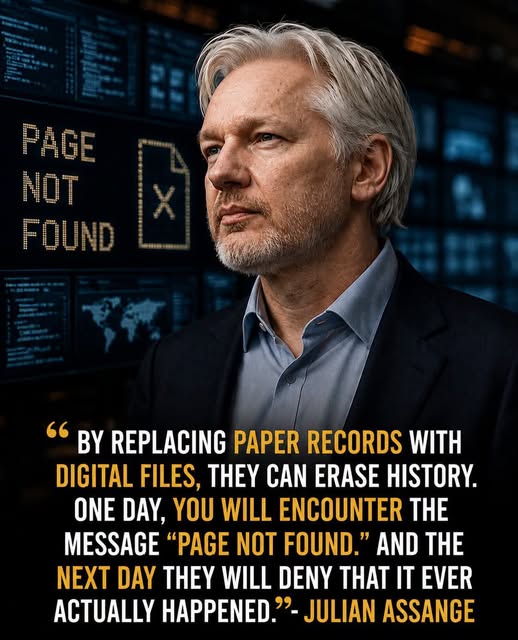
🖥️⚠️ Online Doesn’t Automatically Mean Permanent
We were once told that digitizing records would help preserve information forever.
But digital information can disappear with just a few keystrokes.
That doesn’t mean we should return to rooms overflowing with paper. Digital records have enormous advantages: they can be copied instantly, searched within seconds, shared across the world, and preserved at a scale that physical documents often cannot match.
But digital preservation comes with a vulnerability of its own.
If only one institution controls the copy, that institution also controls whether the copy remains available.
A webpage can be redesigned.
A database can be taken offline.
A file can be deleted.
A dataset can be replaced.
A link can quietly stop working.
The issue became particularly visible in 2025, when researchers, archivists, and other preservation groups worked to capture federal webpages and datasets as government websites were reorganized and information concerning subjects such as climate change, public health, and environmental policy was moved, modified, or removed.
Some information remained available through other sources or archived versions.
But the episode highlighted a fundamental lesson:
Online does not automatically mean permanent.
Fortunately, digital preservation doesn’t depend on a single system.
Organizations such as the Internet Archive preserve enormous numbers of webpages through the Wayback Machine. Libraries, universities, researchers, and independent archival projects also maintain copies of important documents and datasets.
And that points toward perhaps the most important principle of preservation:
Redundancy. 🔐
Multiple copies.
Different institutions.
Independent archives.
Open file formats.
Regular backups.
And, where appropriate, physical copies stored separately from digital systems.
Paper isn’t indestructible. It can burn, decay, flood, or be deliberately destroyed.
Digital information isn’t indestructible either. It can be deleted, corrupted, altered, encrypted, or simply abandoned when the technology needed to read it disappears.
The safest historical record is therefore not necessarily paper or digital.
It’s a record that exists in more than one place and under more than one form of stewardship.
Because when only one person, company, institution, or government possesses the only copy of something important, preservation ultimately depends on that single point of control.
History deserves better than that.
If information matters, make sure it doesn’t have only one home. 📚💾🌎