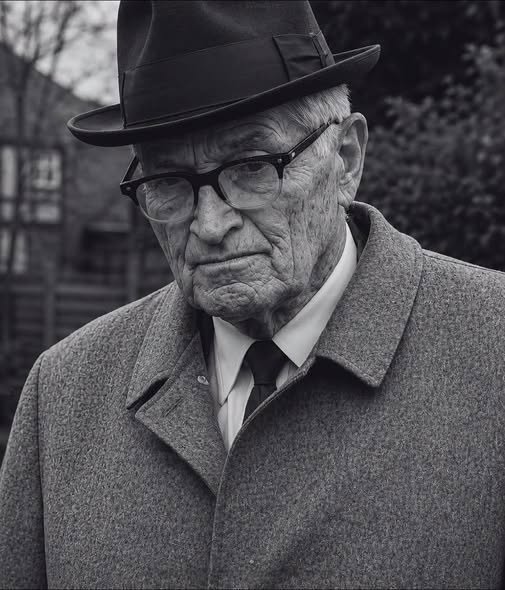
🇺🇸 Harry Truman Went Home When America Had Given Up on Him—and History Eventually Came Back
On the morning of January 20, 1953, Harry S. Truman left the White House for the last time.
There was no grand farewell waiting for him.
No presidential pension.
No permanent government staff.
No former-president office.
The Former Presidents Act would not be passed until 1958, so Truman left Washington without the financial security that former presidents receive today.
His regular income included a modest Army Reserve pension from his World War I service as a captain of field artillery—about $112.56 a month.
So Truman and his wife, Bess, boarded a train at Washington’s Union Station and headed home to Independence, Missouri.
He was leaving office with an approval rating of roughly 32 percent.
Much of the Washington press had turned against him. His second term had been filled with controversy, war, political battles, and exhaustion.
As far as public opinion was concerned, America had delivered its verdict.
Truman went home anyway.
That summer, he bought a Chrysler. He and Bess climbed into the car themselves and drove across the country.
A former president of the United States stopped at ordinary gas stations, filled his own tank, and signed autographs for people who recognized him. 🚗
At one point, Pennsylvania state police even stopped him for driving too slowly.
Back in Independence, Truman answered his own telephone.
He personally responded to thousands of letters.
Almost every morning, he went for his brisk walk through town, sometimes moving so quickly that reporters trying to follow him had to jog. 👟
He didn’t spend his retirement constantly attacking the president who succeeded him.
He didn’t dedicate his remaining years to demanding that America reconsider his presidency.
He simply kept living.
And while Truman was quietly getting on with his life, something else was happening.
History was changing its mind.
In 1948, Truman issued Executive Order 9981, beginning the process of desegregating the U.S. armed forces.
Through the Truman Doctrine and the Marshall Plan, his administration also helped establish America’s postwar strategy for confronting Soviet expansion and supporting the reconstruction of Western Europe.
The Marshall Plan did not single-handedly create the peaceful Europe that followed, but it became a major part of America’s postwar approach to European recovery and stability.
And then there was health care.
In November 1945, Truman became the first U.S. president to formally ask Congress to establish a national health insurance program.
The proposal faced fierce opposition.
The American Medical Association famously attacked it as “socialized medicine.” Conservative members of Congress opposed it, and Truman’s effort ultimately failed.
He tried again.
It failed again.
When Truman left office, the defeat remained one of the disappointments he remembered most bitterly.
Then he went home.
He walked the streets of Independence.
The years passed.
And then, twenty years after Truman first called for national health insurance, another president arrived in Missouri.
On July 30, 1965, President Lyndon B. Johnson traveled to the Harry S. Truman Presidential Library in Independence.
There, with the 81-year-old Truman sitting beside him, Johnson signed the Social Security Amendments of 1965, creating Medicare and Medicaid. 🏥🇺🇸
Johnson looked toward Truman and praised him for giving Americans hope, calling him the “real daddy of Medicare.”
Then Johnson handed signing pens to Truman and Bess.
Six months later, in January 1966, Johnson returned to the Truman Library.
This time, he brought something extraordinary:
The first two Medicare cards issued by the federal government.
The first belonged to Harry S. Truman.
The second belonged to Bess Truman.
Johnson personally handed the cards to them.
Think about that for a moment.
Two decades earlier, Truman had asked America to create national health insurance.
His proposal had been rejected.
He had left office with low approval ratings and a reputation that many believed would not age well.
But twenty years later, the first Medicare card carried his own name.
His work had not disappeared.
It simply took time.
Truman lived another six years and died on December 26, 1972, at the age of 88.
In the decades since his death, historians have dramatically reassessed his presidency. Modern rankings frequently place Truman among America’s most effective presidents, often within the top ten.
And perhaps the most remarkable part is this:
Truman didn’t spend his retirement demanding that history vindicate him.
He didn’t constantly try to rewrite his image.
He didn’t spend his final years insisting that everyone had misunderstood him.
He went home.
He walked.
He answered his own phone.
He drove his own car.
He lived his life.
And eventually, history did the talking for him. 🇺🇸
Some decisions look like failures when they’re made.
Some victories aren’t visible for decades.
And sometimes, the people who feel forgotten by history simply have to keep moving forward long enough for history to catch up.
Because history has a long memory.
Sometimes, it takes twenty years before it finally understands what it was looking at. ⏳❤️