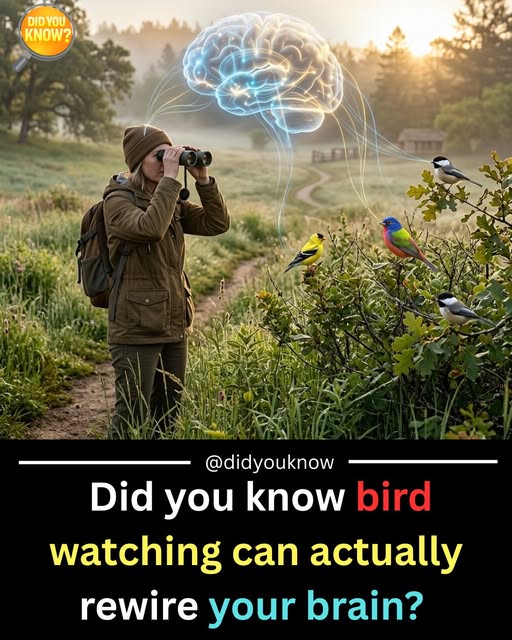
🐦🧠 Did You Know Birdwatching Can Actually Change Your Brain?
What if one of the most peaceful hobbies in the world could also be giving your brain a workout?
Birdwatching may look like a simple activity—standing quietly outdoors with binoculars and waiting for a bird to appear. But experienced birders are doing something much more complex.
They are constantly observing, comparing, remembering, listening, and identifying tiny differences.
And over years of practice, all that mental effort may be reflected in the brain itself.
🔍 Your Brain Gets Better at Seeing What Others Miss
Experienced birdwatchers become remarkably skilled at recognizing subtle details.
A slight difference in plumage.
The shape of a beak.
A particular wing movement.
A bird’s silhouette against the sky.
Even the habitat where a bird appears can provide an important clue.
Repeatedly performing these tasks engages brain systems involved in visual recognition, memory, attention, and auditory processing. Research on expertise and neuroplasticity suggests that sustained practice can strengthen and refine the neural networks involved in skills we repeatedly use.
In other words, the more carefully you observe nature, the more efficiently your brain may learn to process what you’re seeing.
🧠 Birdwatching Is a Multisensory Workout
That’s what makes birdwatching particularly fascinating.
A birder isn’t using just one sense.
They might identify a species by its colors and markings, track its movement through trees, remember where it was previously spotted, recognize the surrounding habitat, and distinguish its song from dozens of other sounds.
It’s almost like a mental puzzle unfolding in real time.
Studies of other highly trained individuals have shown similar patterns of brain adaptation. London taxi drivers, for example, became famous in neuroscience research for changes associated with extensive navigation experience. Professional musicians have also demonstrated specialized adaptations related to intensive auditory training.
Birdwatching belongs to that same broader story:
The brain adapts to what we repeatedly ask it to do.
🎵 And Then There’s the Sound of Birds
Birdwatching isn’t only about what you see.
It’s also about what you hear.
Experienced birders can learn to distinguish remarkably similar calls and songs, sometimes identifying a species without seeing it at all.
That requires attention, memory, auditory discrimination, and pattern recognition.
And there may be another benefit to simply listening.
Research has suggested that exposure to natural sounds—including birdsong—can be associated with reduced stress and improved mood. 🌿🎶
So when someone sits beneath a tree listening to birds instead of scrolling through a phone, they may be doing more than enjoying a peaceful moment.
They may be giving their mind an opportunity to slow down and refocus.
🌱 The Most Amazing Part? You Don’t Have to Be Born With the Skill
Perhaps the most encouraging thing about all of this is neuroplasticity—the brain’s remarkable ability to change and adapt throughout life.
You don’t need to be a professional ornithologist.
You don’t need perfect eyesight or an encyclopedic knowledge of species.
You can start with one bird.
Learn its call.
Notice its shape.
Remember where you found it.
Then find another.
Over time, those tiny observations accumulate.
The beginner who once saw “a bird in a tree” may eventually notice the species, sex, behavior, habitat, flight pattern, and even the subtle differences between its calls.
That’s expertise being built one observation at a time.
🐦 Nature May Be One of the Best Brain Exercises Around
Birdwatching reminds us that a cognitive workout doesn’t always have to look like a crossword puzzle or a computer game.
Sometimes, it looks like standing quietly in a park.
Sometimes, it sounds like birdsong.
And sometimes, it means spending ten minutes trying to figure out which tiny creature just disappeared behind a branch. 😄
The brain is constantly shaped by what we pay attention to.
So perhaps every walk through the woods, every new bird identified, and every song learned is doing something more profound than we realize.
**You’re not just watching the birds.
You’re teaching your brain how to see the world a little more carefully. 🐦🌳🧠**