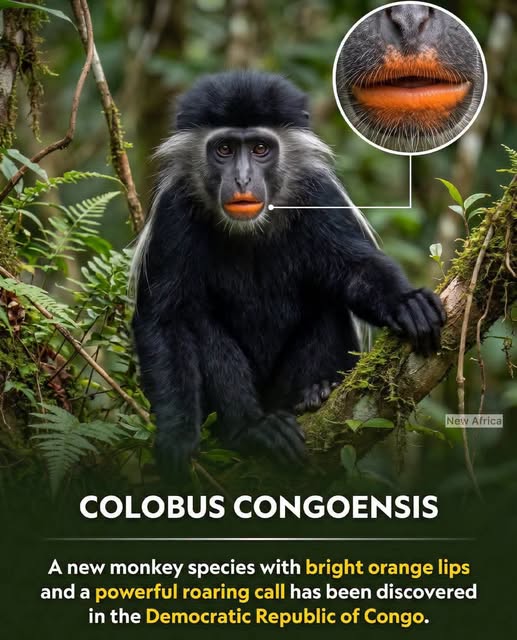
🐒🌿 Meet Likweli: The Striking African Monkey Scientists Have Only Just Recognized
Deep inside the dense forests of the Democratic Republic of the Congo, scientists have confirmed the existence of a remarkable monkey unlike any other.
Known scientifically as Colobus dongdensis and locally referred to as Likweli, this newly recognized primate is already attracting attention for its unusual appearance, distinctive voice, and uncertain future.
And perhaps the most surprising part?
It may have been living in these forests for generations before science formally recognized it as a separate species.
🧡 A Monkey With an Unforgettable Face
Likweli isn’t exactly easy to mistake for an ordinary monkey.
It is known for its vibrant orange lips, striking mask-like facial markings, and an unusually deep, resonant roar that carries through the forest.
These distinctive characteristics helped researchers recognize that they were looking at something special.
But appearances alone weren’t enough.
Scientists turned to genetic analysis, which provided evidence that Colobus dongdensis represents a distinct species rather than simply a variation of another known colobus monkey.
That makes the discovery particularly significant.
🌍 One of Only a Handful of New African Monkey Species
The recognition of Likweli is especially notable because formally identifying a completely new African monkey species is extremely rare.
According to the information surrounding the discovery, it joins only a small group of African monkey species formally recognized during the past 75 years.
That makes this more than an exciting addition to a scientific list.
It is a reminder that Earth’s forests can still hold biological mysteries waiting to be uncovered.
Even in an age of satellites, DNA sequencing, and sophisticated wildlife surveys, there are animals living in remote ecosystems that scientists are only beginning to understand.
⚠️ Discovered—and Already in Danger?
Unfortunately, Likweli’s story comes with a troubling warning.
Researchers are concerned that the species could already be vulnerable because it appears to have a limited geographic range, while the forests it depends upon are experiencing rapid habitat degradation.
That creates a heartbreaking possibility:
Humanity may have only just formally recognized this monkey while its habitat is already disappearing.
For a species restricted to a relatively small area, losing forests can have devastating consequences.
Every patch of habitat can matter.
🌳 A Discovery That Comes With Responsibility
The story of Likweli is a beautiful reminder that discovery and conservation are deeply connected.
Finding a new species isn’t the end of the story.
In many cases, it is the beginning.
Once scientists understand what an animal is, where it lives, and what makes it unique, conservationists can begin asking the most important questions:
How large is its population?
How much habitat remains?
What threats does it face?
And, most importantly, what can be done to protect it?
Somewhere beneath the towering trees of the Congo rainforest, Likweli continues to live its life—moving through the forest, calling into the dense canopy, and playing its part in an ecosystem that has existed long before humans gave it a scientific name. 🐒🌿
Its discovery is exciting.
But its future may depend on whether we can protect the forest that gave scientists the chance to find it.
Sometimes, discovering a new species doesn’t just teach us something about nature—it reminds us how much nature still has to lose. 💚