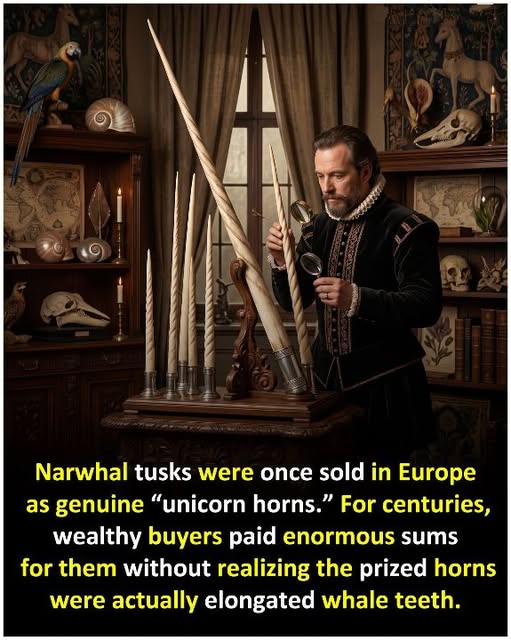
🦄🌊 The “Unicorn Horns” That Were Actually Narwhal Tusks
For centuries, Europeans believed they had proof that unicorns were real.
The evidence was strange, beautiful, and incredibly valuable: long, spiraling horns that could measure several feet in length.
Kings wanted them.
Churches displayed them.
Wealthy collectors paid fortunes for them.
There was only one problem…
They didn’t come from unicorns. 😮
They came from narwhals.
🐋 A Mystery From the Arctic
Narwhals live in the cold Arctic waters, far from most medieval European communities. Because Europeans rarely encountered living narwhals, there was little understanding of where their remarkable spiral tusks actually came from.
Instead, a fascinating explanation emerged.
Unicorn horns. 🦄
The tusks were sometimes treated as precious objects with extraordinary powers. People believed they could protect against poison and possessed medicinal or magical properties.
Owning one wasn’t simply a matter of curiosity.
It could be a powerful symbol of wealth, status, and even protection.
Some rulers and wealthy collectors were willing to pay enormous sums to obtain these supposed pieces of a mythical creature.
💰 A “Unicorn Horn” Worth a Fortune
One famous example was associated with Lorenzo de’ Medici, the powerful Florentine ruler and patron of the arts.
When Lorenzo died in 1492, one of the supposed unicorn horns in his collection was reportedly valued at 6,000 florins—an extraordinary amount at the time.
Imagine paying a fortune for the horn of a creature that didn’t actually exist. 😳
Yet from the perspective of medieval Europeans, the belief wasn’t necessarily as strange as it sounds today.
The Arctic was a distant and mysterious place, and narwhals themselves were largely unknown. Without modern zoology, photographs, documentaries, or scientific expeditions, an enormous spiral “horn” was easy to associate with the legendary unicorn.
🦷 The Truth Was Hidden in Plain Sight
The reality is almost as fascinating as the myth.
A narwhal’s famous “tusk” is actually an extremely elongated tooth—usually the left upper canine.
In males, it can grow several meters long and develops the distinctive spiral pattern that made it look so much like the legendary horn of a unicorn.
So those mysterious objects sitting in European treasure rooms weren’t magical horns at all.
They were extraordinary teeth from an Arctic whale. 🐋
✨ From Myth to Science
The story of the narwhal tusk is a perfect example of how humans once tried to explain the unknown.
A rare object arrives from a distant land.
Nobody knows exactly where it came from.
A legendary explanation fills the gap.
And suddenly, a whale’s tooth becomes a unicorn’s horn worth a fortune.
Today, the mystery has been solved—but perhaps that’s what makes the history so fascinating.
The unicorn wasn’t real. The horn was.
It just belonged to a creature even stranger than the myth. 🦄🐋💙