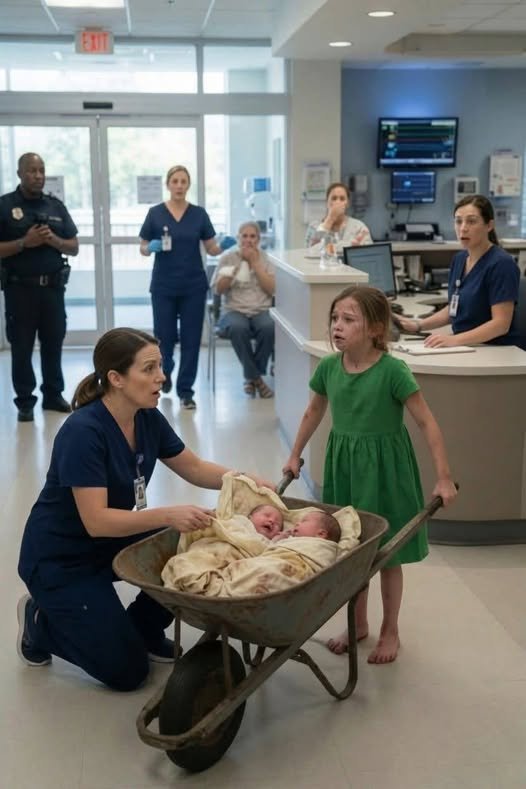
The officer stared at his partner.
Neither man spoke for several seconds.
Then he slowly pointed toward the kitchen table.
“Don’t touch anything.”
His partner looked down.
A glass of water sat beside an unopened bottle of medicine.
Next to it was a small white envelope.
And beneath the envelope was a photograph.
But it wasn’t the photograph that made the officer’s face change.
It was the handwriting on the envelope.
Three words had been written across the front:
FOR MY DAUGHTER.
The officer swallowed.
“Call the hospital.”
His partner reached for the radio.
“Why?”
“Because I think we just found out why that little girl was sent there.”
He carefully photographed the envelope before opening it.
Inside was a single sheet of paper.
The handwriting was shaky.
The first sentence read:
If my daughter reaches the hospital with the babies, please believe her.
The officer stopped reading.
His eyes moved to the second line.
Then the third.
And suddenly the room felt much colder.
Back at the hospital, I was sitting beside the little girl when the phone rang.
The social worker answered.
Her expression changed almost immediately.
She looked at me.
Then at the child.
Then she slowly stood.
“Excuse me,” she said.
She walked several steps away before lowering her voice.
“Yes.”
A pause.
“What?”
Another pause.
Her face lost all color.
She looked toward the pediatric ward.
Then she whispered:
“Are you absolutely certain?”
The little girl noticed.
Children always notice when adults are afraid.
She reached for my hand.
“Is my mommy okay?”
I squeezed her tiny fingers.
“We’re trying to find out.”
She shook her head.
“No.”
Her voice was barely audible.
“You found something.”
I looked at her.
“What makes you say that?”
“Because grown-ups get quiet when they find something bad.”
I didn’t know what to say.
Then the social worker came back.
She crouched in front of the girl.
“Sweetheart, what’s your mother’s name?”
The child told her.
“And how old is your mother?”
She answered.
“Does your mother take medicine?”
The girl nodded.
“What kind?”
The little girl looked down.
“White ones.”
“Do you know what they’re called?”
“No.”
She rubbed her eyes.
“Mommy said they made her sleepy.”
The social worker exchanged a look with me.
Then she asked the question that changed everything.
“Sweetheart, did your mother take those pills herself?”
The little girl shook her head.
“No.”
“Who gave them to her?”
The child became completely still.
For several seconds, she said nothing.
Then she whispered:
“A man.”
The social worker’s voice softened.
“What man?”
“My uncle.”
My heart dropped.
“You have an uncle?”
The girl nodded.
“He came last week.”
“What did he do?”
“He fought with Mommy.”
“About what?”
The girl stared at the floor.
“She wouldn’t give him the babies.”
Nobody spoke.
The little girl’s fingers tightened around mine.
“He said the babies belonged to him.”
In the house, the officers had finally finished photographing the kitchen.
The second officer picked up the letter again.
This time he read it all.
The mother had written that she had become frightened after a relative began demanding custody of the newborn twins.
She believed someone had been entering the house at night.
She had changed the locks.
She had hidden important documents.
And then, three days earlier, she had begun feeling unusually weak.
The final part of the letter was written in much larger handwriting.
If I become unconscious, take my children somewhere safe.
Below that was another sentence.
My seven-year-old knows where the hospital is because I taught her the route.
The officer lowered the paper.
His partner stared at him.
“She knew this might happen.”
“No,” the first officer said quietly.
“She knew someone was coming.”
Then they heard a sound from the hallway.
A floorboard creaked.
Both officers froze.
The front door was still open.
But nobody had entered through it.
The second officer reached for his weapon.
“Who’s there?”
Silence.
Then another creak.
This time from upstairs.
The officers moved carefully toward the staircase.
At the top was a narrow hallway.
Three doors.
One bathroom.
One bedroom.
And one nursery.
The nursery door was locked.
The officer tried the handle.
Nothing.
He looked at his partner.
“Break it.”
The door gave way on the second strike.
Inside were two empty cribs.
A rocking chair.
A pile of folded baby clothes.
And a large wooden chest.
The chest was open.
Inside were dozens of photographs.
The officer picked up the first one.
It showed the mother holding the twins in the hospital.
The second showed the little girl smiling beside them.
The third made him stop breathing.
It showed a man standing outside the house.
The photograph had clearly been taken from inside the nursery.
On the back was a handwritten date.
Three nights before the mother became unconscious.
And beneath the date were six words:
HE THINKS I DON’T KNOW HIM.
The officer stared at the photograph.
His partner leaned over.
“Do you recognize him?”
The officer didn’t answer.
Because he did.
The man in the photograph wasn’t a stranger.
He was the children’s uncle.
And according to the mother’s letter…
He was the last person she had allowed inside the house.
At the hospital, one of the twins suddenly cried.
Everyone in the neonatal room turned.
It was the first strong cry either baby had made since arriving.
The little girl heard it from the hallway.
Her face changed instantly.
“My brother!”
She tried to run toward the nursery.
A nurse caught her gently.
“You can’t go inside yet.”
“But he woke up!”
“Yes.”
“Is he okay?”
The nurse smiled through tears.
“He’s fighting.”
The girl nodded.
“So am I.”
Then she looked at me.
“Can you promise me something?”
“What?”
“If Mommy wakes up before I come back…”
She swallowed.
“Tell her I didn’t leave her.”
I knelt beside her.
“You saved your brothers.”
She shook her head.
“No.”
Her eyes filled.
“I saved everybody.”
Before I could ask what she meant, the hospital doors opened.
Two police officers rushed inside.
The first one was carrying the mother’s letter.
The second was carrying the photograph.
He looked directly at the little girl.
“Sweetheart…”
He crouched down.
“We need to ask you one more question.”
The child nodded.
“Do you know this man?”
He turned the photograph around.
The little girl looked at it.
And the moment she saw the face, she stopped breathing.
Her lips began to tremble.
Then she whispered:
“That isn’t my uncle.”
The officer frowned.
“Who is he?”
The little girl looked toward the neonatal ward.
Then she looked back at the photograph.
And in a voice barely louder than a breath, she said:
“That is the man Mommy told me to run from.”
The room went completely silent.
Then the little girl pointed at the photograph again.
“He came to our house yesterday.”
The officer’s face hardened.
“Yesterday?”
The girl nodded.
“But you said your mother had been asleep for three days.”
“I know.”
“Then how could he have come yesterday?”
The little girl looked at him with frightened eyes.
“He didn’t come to the house yesterday.”
She pointed toward the hospital doors.
“He followed me here.”
And at that exact moment…
the automatic doors at the emergency-room entrance opened.
A tall man stepped inside.
He looked around the room.
Then smiled.
Because he already knew exactly where the twins were.