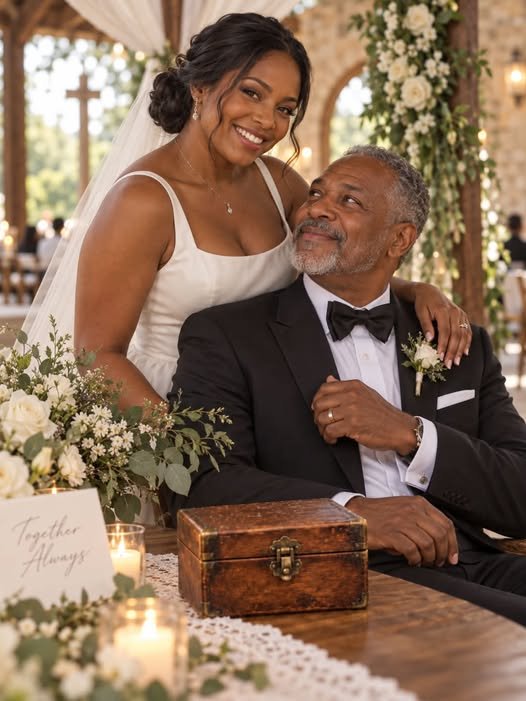
The solicitor watched me open the first envelope.
His children watched too.
Nobody said anything.
The paper inside was folded twice.
I knew Rowland’s handwriting immediately.
I had spent six years seeing it on shopping lists, birthday cards, notes beside the kettle.
The date at the top was six months before our wedding.
I began reading.
Dear Arthur,
I stopped.
“Arthur?”
The solicitor nodded.
“His old solicitor before me.”
I looked at the first paragraph again.
I have met the woman I intend to marry. Before you ask, no, she does not know what I am doing. She must not know yet.
My fingers tightened around the paper.
His daughter leaned forward.
“What does it say?”
I looked at her.
“You can read it yourself when I’m finished.”
She looked offended.
The solicitor said quietly, “Let her continue.”
I read on.
My children believe she wants my money. They may be right about part of it. She has debts. She has nowhere secure to go. But that isn’t why I chose her.
I swallowed.
The next line was underlined.
I chose her because she has no idea who she is.
I stopped breathing.
I read it twice.
Then a third time.
“What does that mean?”
The solicitor didn’t answer.
His son looked at his sister.
She shook her head.
I continued.
She thinks her father abandoned her when she was nine. He didn’t.
The room became very quiet.
I looked up.
“My father?”
The solicitor finally spoke.
“Read the rest.”
My father had disappeared when I was nine.
That was the story I had been given.
He left.
He didn’t want children.
He had another family.
My mother had repeated it so many times that eventually I stopped asking questions.
I looked back at the letter.
Her father did not abandon her. He was trying to protect her.
The words blurred.
I blinked hard.
Then I saw the next paragraph.
He came to me in 1998. He knew I was investigating the same people he had been investigating. He gave me documents. Names. Account numbers. Copies of transactions.
My husband’s son suddenly spoke.
“What people?”
The solicitor looked at him.
“Your father didn’t leave instructions for you to ask questions yet.”
His son leaned back.
I kept reading.
I promised him I would keep his daughter safe if anything happened to him.
My hand went cold.
Six months before Rowland proposed, he had known my father.
He had known things about my childhood I didn’t know myself.
And he’d married me anyway.
Not because he was lonely.
Not because he wanted a young wife.
Because of a promise.
I turned the page.
There was only one sentence on the back.
The man who killed her father is still alive.
I dropped the letter.
His daughter stood up so quickly her chair struck the wall.
“That isn’t funny.”
“I don’t think he was trying to be funny,” I said.
She stared at me.
For the first time, she wasn’t looking at me like a gold digger.
She looked frightened.
The solicitor picked up the letter.
“There are ten more.”
“Why eleven?”
He hesitated.
“Because the eleventh was written three days before Rowland died.”
I stared at him.
“Then why didn’t he tell me?”
“Because he believed telling you would put you in greater danger.”
I laughed.
It came out wrong.
“Greater danger?”
The solicitor opened the wooden box again.
Beneath the remaining envelopes was a small key.
He placed it on the desk.
“This was attached to the box when Rowland delivered it to my office.”
“What does it open?”
“We don’t know.”
His daughter frowned.
“You don’t know?”
“No.”
I picked up the key.
There was a number engraved on it.
17.
I recognized it immediately.
My husband had worn the same number on a brass keychain for years.
I’d asked him about it once.
He’d kissed my forehead and said:
“Something I don’t need anymore.”
I had forgotten about it.
Until now.
The solicitor reached for the second letter.
“This one explains the money.”
I opened it.
The first sentence made my stomach drop.
The forty-one thousand pounds my wife owes is not a coincidence.
I looked at the solicitor.
“What?”
He nodded toward the letter.
I read.
Six years ago, I arranged for the debt to be purchased.
My mouth went dry.
My flat.
My debt.
The forty-one thousand pounds that had nearly ruined me.
Rowland had known about it before we married.
But the next sentence was worse.
I did not create the debt. Someone else did.
I stared at the page.
And they did it because they were looking for her.
I couldn’t move.
His daughter whispered:
“Looking for who?”
The solicitor answered before I could.
“You.”
I looked at the wooden box.
At the eleven letters.
At the key marked seventeen.
Then I remembered something Rowland had said to me on our first anniversary.
I’d thought it was an odd joke.
He’d been standing at the kitchen window, watching me wash glasses.
He’d said:
“If anyone ever asks you about your father, don’t tell them what you know.”
I’d laughed.
I hadn’t known anything.
Now I understood.
I knew nothing because someone had spent twenty-five years making sure I didn’t.
The solicitor pushed the third letter toward me.
“This one,” he said, “is why Rowland wanted his children in the room.”
His daughter frowned.
“Why?”
The solicitor looked directly at her.
“Because your father believed one of you had already been contacted.”
Her face went white.
Her brother slowly turned toward her.
“What does that mean?”
She didn’t answer.
The solicitor reached into the box and removed one final item.
A photograph.
It showed Rowland standing beside a younger man outside a bank.
I recognized the younger man.
I had seen him at my wedding.
He had laughed when Rowland’s daughter took my speech away.
He had sat beside Rowland’s accountant.
The man who had been his accountant since 1991.
I turned the photograph over.
Three words were written on the back.