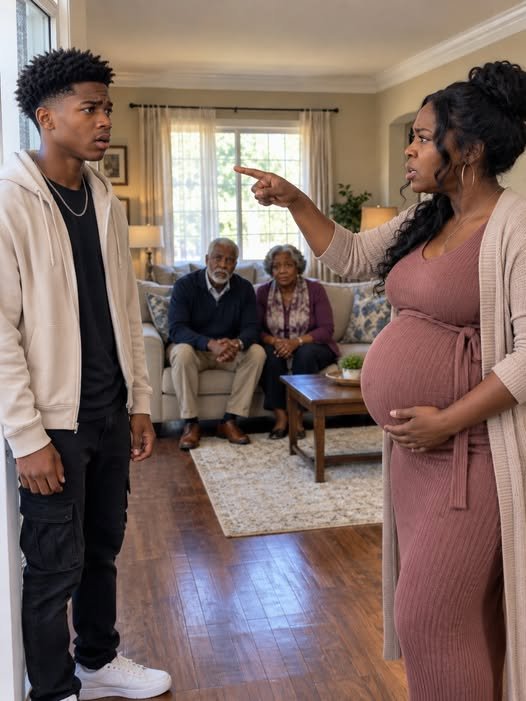
I spent the first night in a bus station.
Not because I had nowhere else to go.
Because I was seventeen and too ashamed to knock on anyone’s door.
By morning, I had forty-three dollars in my pocket, a split lip, and one backpack.
My girlfriend, Emily, was the only person I thought might believe me.
She didn’t.
She met me outside the diner where we’d agreed to talk.
I remember how she looked at me.
Not angry.
Afraid.
She wouldn’t even stand close.
“Tell me she’s lying.”
I said, “She is.”
“Then why would she say it?”
I didn’t have an answer.
That was the question that followed me for years.
Why would someone destroy their own life just to destroy mine?
Emily started crying.
“My parents said I can’t see you anymore.”
I nodded.
She handed me a small envelope.
Inside was a photograph of us from the summer before.
On the back, she’d written:
I’m sorry.
Then she walked away.
That was the last time I saw her for ten years.
I worked wherever someone would hire a seventeen-year-old who didn’t ask too many questions.
A warehouse.
A diner.
Construction.
Eventually, I rented a room above a mechanic’s shop.
It wasn’t much.
But nobody there knew my name.
And nobody there knew what my family had said about me.
For years, I didn’t talk about that night.
Not to anyone.
I became very good at saying:
“My family and I don’t get along.”
That was easier than explaining why.
At eighteen, I stopped expecting my parents to call.
At nineteen, I stopped checking my mother’s number.
At twenty-one, I deleted every photograph of my childhood.
At twenty-three, I stopped wondering whether my sister had ever regretted what she’d done.
And at twenty-seven, I finally thought I was free.
Then, one Tuesday morning, I received an envelope.
No return address.
Inside was a single photocopy.
A hospital record.
I read it once.
Then twice.
Then a third time.
The date of the pregnancy test was there.
So was the estimated conception date.
My hands started shaking.
Because I knew exactly where I had been during that period.
I had been away at a school competition.
Three hundred miles from home.
There were photographs.
Team records.
Hotel receipts.
And something else.
Something I hadn’t known existed.
A second name appeared on the hospital document.
The name of the baby’s biological father.
I stared at it for nearly a minute.
Then I whispered:
“No.”
Because the name wasn’t mine.
It belonged to someone else.
Someone my sister had known.
Someone who had been in our house that night.
Someone my parents had never suspected.
I immediately called the number printed on the envelope.
A woman answered.
“Did you get the documents?”
“Who are you?”
There was a long silence.
Then she said:
“My name is Rebecca.”
I sat down.
“Rebecca who?”
Her voice trembled.
“Rebecca Hale. I was the social worker assigned to your sister’s case.”
My stomach dropped.
“You knew?”
“I knew there was something wrong.”
“Then why didn’t you tell anyone?”
“I tried.”
My hand tightened around the phone.
“What do you mean, you tried?”
She took a breath.
“Your parents wouldn’t listen.”
I closed my eyes.
“Why?”
“Because by the time I met your sister, she’d already told them what happened.”
I could barely speak.
“So why contact me now?”
Another silence.
Then Rebecca said something I had spent ten years imagining but never actually expected to hear.
“Because your sister finally confessed.”
I stood up.
“When?”
“Three weeks ago.”
My heart started pounding.
“What did she say?”
Rebecca’s voice became quieter.
“She told me you never touched her.”
I couldn’t breathe.
“She said she made the whole thing up.”
I gripped the edge of the table.
“Why?”
Rebecca didn’t answer immediately.
Then she said:
“Because she was afraid someone would discover who the baby’s father really was.”
I stared at the wall.
“Who?”
Rebecca whispered the name.
And suddenly that Saturday night came rushing back.
My father’s hand.
My mother’s scream.
My brother telling me to leave.
Thirty-one adults watching me walk out.
And one person in that room who had never looked surprised.
My father.
I hung up.
Then I opened the second document.
It wasn’t a hospital record.
It was a letter.
Written in my sister’s handwriting.
Only six words were underlined.
Dad told me what to say.
I read those words again.
And again.
Then my phone started ringing.
My mother.
I didn’t answer.
It rang again.
My father.
Then my brother.
Then numbers I hadn’t saved.
One after another.
For the first time in ten years, my entire family was trying to reach me.
And this time, I knew why.
They weren’t calling because they missed me.
They were calling because the truth had finally become more frightening than the lie.
That evening, I went home.
And I found six cars parked outside my house.
My mother was standing on my doorstep.
My father was beside her.
My brother was crying.
And behind them stood my sister.
The girl who had destroyed my life at seventeen.
She looked at me through the window.
Then she fell to her knees.
My mother raised both hands toward the glass.
“Please.”
I stood there silently.
My father wiped his face.
“I was wrong.”
I didn’t move.
He came closer to the door.
“Son…”
I reached for the curtain.
And before I closed it, my sister looked straight at me and mouthed:
“I’M SORRY.”
Then I pulled the curtain shut.
I didn’t open the door.
Not that night.
Not the next morning.
And not when my father left a letter underneath it.
Because for ten years, they had wanted me to prove I wasn’t guilty.
Now they knew.
And for the first time in my life…
they were the ones begging me to believe them.