He didn’t read them. He didn’t burn them, either—which was worse, somehow. He had kept them, like trophies or contraband, hidden beneath rusty screwdrivers and dried paint cans in the cold damp of the shed.
Nine envelopes, all bearing my name in my boy’s familiar, looped handwriting.
My husband’s voice sounded thin, stripped of all its military authority as he stood in our hallway, staring at the floorboards. “I did it for the family,” he muttered, his hands trembling against his thighs. “He was a distraction. He was going to ruin everything you and I were trying to build.”
I didn’t yell. I didn’t scream. The rage inside me was too heavy, too cold for noise.
Six years. Six years of waking up in the middle of the night wondering if my child was sleeping under a bridge, if he was safe, if he hated me. Six years of believing my son had discarded me the moment he turned eighteen, while the man sleeping beside me every night watched me grieve in silence.
I turned away from my husband and looked at the young man standing on my porch.
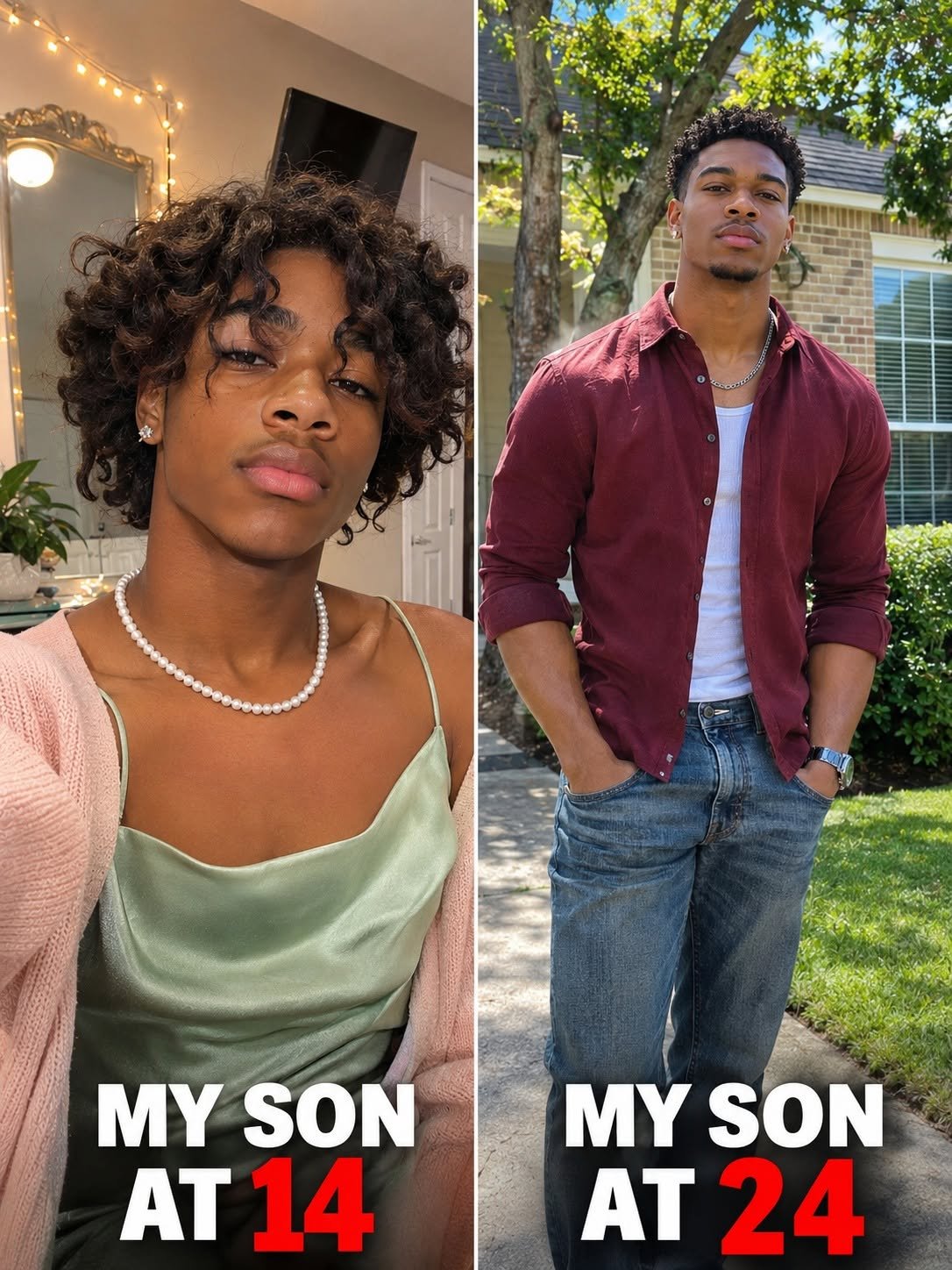
The heels were gone. The makeup was gone. But beneath the broad shoulders and the plain jacket, his eyes were still the exact same eyes that used to look up at me when he was four years old.
“Did you write to tell me you were okay?” I asked, my voice barely a whisper.
My son swallowed hard, his posture softening just a fraction. “The first three were to tell you where I was,” he said quietly. “The fourth was to ask if I could come home for Christmas. By the ninth one… I was just asking why you hadn’t replied.”
A tear finally broke and slid down my cheek. “I never saw them. I swear on my life, my love, I never saw a single one.”
My husband took a step forward, reaching out a hand. “Mary, please, listen to me—”
“Get out,” I said.
He froze. “What?”
“Get out of my house,” I turned on him, my voice cracking like a whip. “Get your coat, get your keys, and get out before I throw every single thing you own into the street.”
He tried to argue, his face flushed with panic, but I didn’t give him another second. I walked to the front door, grabbed his coat off the rack, and shoved it into his chest. When he hesitated on the threshold, I shut the door in his face and turned the deadbolt.
The silence in the hallway was deafening.
I looked at my son. The space between us felt like a canyon built out of six lost years, but for the first time, the mist was beginning to clear.
“He’s gone,” I whispered, wiping my face with the back of my hand.
My son looked at the closed door, then down at his hands, and finally back at me. Slowly, the rigid, guarded stance he had held since walking up the driveway began to crumble.
“I thought you chose him over me,” he admitted, his voice breaking.
“I would never,” I said, taking one small, tentative step toward him. “Not in a million years. Not for a single second.”
He didn’t step back this time.
When I wrapped my arms around him, he buried his face into my shoulder, leaning his full weight against me just like he used to when he was small. And as we stood there in the quiet hallway, holding onto each other, I knew it would take time to rebuild everything that had been stolen from us—but the lie was finally dead, and my boy was home.