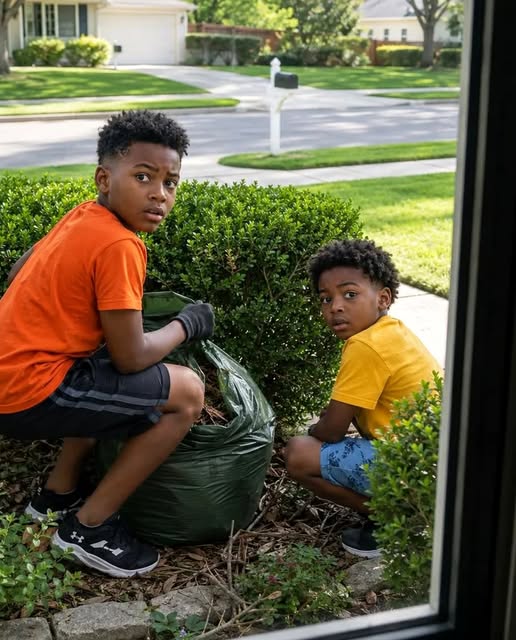
The Neighbor’s Kids Cleaned Our Street Every Sunday — Then I Saw What They Were Actually Hiding
Because inside the plastic was a small brown envelope.
My name was written across the front.
Not my nickname.
Not my house number.
My full name.
Daniel Carter.
I stared at it for several seconds, trying to understand how two children could possibly have something addressed specifically to me.
Then I noticed the handwriting.
My hands began to shake.
I knew that handwriting.
It belonged to my wife.
A woman who had been dead for six years.
I tore open the envelope.
Inside was a single photograph.
It showed my wife standing beside a man I had never seen before.
On the back, someone had written:
“Daniel, if you are reading this, they finally found you.”
My heart began pounding.
I looked toward the house next door.
The curtains were closed.
No movement.
I turned the photograph over again.
There was another message beneath the first.
“Do not trust the woman who lives beside you.”
I froze.
My neighbor.
The children’s mother.
The woman I had spoken to dozens of times.
The woman who had always seemed nervous whenever I mentioned my late wife.
Suddenly, every strange detail I’d ignored over the past few months returned at once.
The children’s Sunday cleaning.
Their constant glances toward my house.
Their mother’s nervousness.
And the fact that they never allowed anyone to help them.
I slipped the photograph into my pocket and carried the envelope inside.
I locked the door.
Then I pulled out my phone and searched through the old photographs stored on my computer.
My wife’s photograph was taken shortly before she died.
She had been investigating something at the time.
She never told me what.
I remembered our final conversation.
She had stood in the kitchen, holding a folder against her chest.
“You need to promise me something,” she’d said.
I laughed.
“Anything.”
“If anything happens to me, don’t assume it was an accident.”
At the time, I thought she was being paranoid.
Three days later, she died in a car accident.
The police called it unfortunate.
I called it fate.
Now, sitting alone at my kitchen table, I wasn’t so sure.
I looked again at the photograph.
Then I noticed something I’d missed.
There was a building in the background.
A red-brick warehouse with a faded sign above the entrance.
I recognized it.
It was an old storage facility on the eastern edge of town.
My wife had once mentioned that place.
I grabbed my coat.
But before I could leave, someone knocked on my door.
I looked through the window.
The little boy from next door stood on my porch.
Alone.
His sister was nowhere in sight.
I opened the door slightly.
“What happened?”
He looked frightened.
“Mr. Carter, you found it.”
My stomach tightened.
“Found what?”
“The envelope.”
He glanced over his shoulder.
Then whispered:
“My mom told us never to let you find out.”
“Find out what?”
His eyes filled with tears.
“That you’re not the person she thinks you are.”
I stared at him.
“What does that mean?”
Before he could answer, a car horn sounded from across the street.
The boy flinched.
He grabbed my sleeve.
“Please don’t tell my mom I came here.”
Then he ran.
I watched him disappear around the corner.
Seconds later, the curtains in the house next door moved.
Someone had been watching us.
I closed the door and locked it.
Then I opened the photograph again.
This time, I studied the man standing beside my wife.
There was something familiar about his face.
I couldn’t place it.
Until I noticed the small scar above his eyebrow.
My breath caught.
I’d seen that scar before.
In a photograph hanging inside my own house.
A photograph of my father.
My father had died when I was twelve.
But the man in my wife’s photograph had the exact same scar.
I pulled open an old family album.
There he was.
My father.
Same eyes.
Same scar.
Same face.
Except the photograph my wife had left behind had been taken decades after my father’s supposed death.
I sat down slowly.
My entire understanding of my family had just shifted.
Then my phone rang.
The number was unknown.
I answered.
Nobody spoke for several seconds.
Then an elderly man’s voice whispered:
“Daniel, your wife didn’t die because of what she discovered.”
I couldn’t breathe.
“Who is this?”
“She died because she discovered who you really are.”
The call ended.
I stood completely still.
Then someone knocked again.
This time, it wasn’t the boy.
It was his sister.
She was crying.
She held another black trash bag against her chest.
“Mr. Carter,” she whispered.
“You have to leave.”
“Why?”
She looked toward her house.
“Because my mother knows you found the envelope.”
Then she reached into the bag.
And pulled out a second photograph.
I looked at it.
My blood ran cold.
It showed me.
Standing outside my own house.
Taken six years ago.
On the day my wife supposedly died.
Except I wasn’t supposed to have been there.
Because according to every record I had ever seen…
I had been three hundred miles away.
The girl stared at me.
“That’s why Mom made us clean your street.”
I swallowed.
“Why?”
She whispered the words that changed everything.
“Because every Sunday, we were looking for evidence that someone had been coming back.”
I looked toward my house.
“Someone?”
She nodded.
“Your wife.”
Then she handed me the photograph.
“She isn’t dead.”
And suddenly, the woman I had mourned for six years wasn’t the greatest mystery anymore.
The greatest mystery was why she had spent six years hiding from me.