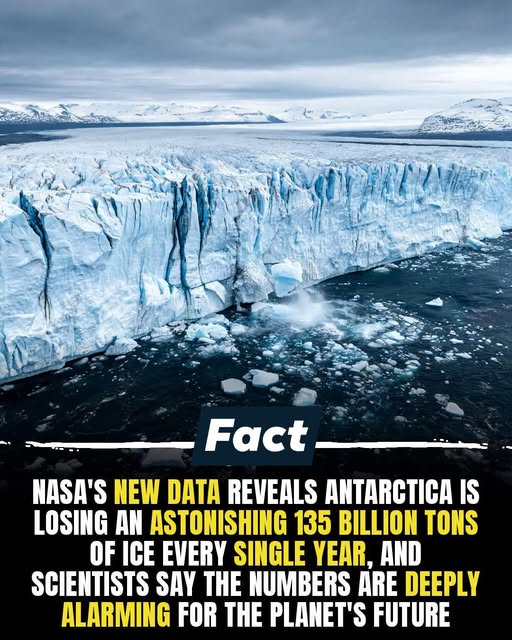
❄️ Antarctica Is Losing Billions of Tons of Ice — And the World Is Watching
Antarctica can feel like a world far removed from everyday life.
But what happens on the frozen continent doesn’t stay there.
Every year, Antarctica loses billions of tons of ice, and satellite observations show that its ice sheets have experienced significant mass loss since the early 2000s. The changes are particularly concerning in parts of West Antarctica and the Antarctic Peninsula. 🛰️🌊
🌊 The Melting Isn’t Happening Only From Above
When we picture Antarctic ice melting, it’s easy to imagine sunlight warming the surface.
But a major part of the story is happening beneath the ice.
Warmer ocean water can flow underneath floating ice shelves, gradually melting them from below. These shelves act somewhat like barriers that help slow the movement of glaciers behind them.
As an ice shelf thins or loses stability, glaciers can flow more quickly toward the ocean, sending additional land-based ice into the sea.
And that’s where the global consequences become much more significant.
🛰️ Satellites Are Measuring Antarctica’s Changing Mass
Scientists don’t have to stand on the ice to measure these enormous changes.
Satellites such as those from NASA’s GRACE mission have been used to detect changes in Earth’s gravitational field.
Why does gravity matter?
Because areas containing less mass exert slightly less gravitational pull.
By repeatedly measuring these tiny changes, researchers can estimate how much ice Antarctica is gaining or losing over time.
Month after month, year after year, the measurements create a remarkable record of a continent in transition.
🌊 Why Should the Rest of the World Care?
Land-based Antarctic ice that melts and enters the ocean contributes to global sea-level rise.
That matters far beyond Antarctica.
Higher sea levels increase the risks faced by coastal communities, particularly during storms and extreme high tides. Over time, continued ice-sheet loss could make flooding increasingly difficult for vulnerable regions to manage.
The amount of ice stored in Antarctica is enormous, which is why scientists pay such close attention to changes there.
⚠️ West Antarctica Is Especially Concerning
Not every part of Antarctica is responding in exactly the same way.
West Antarctica contains several glaciers that are particularly vulnerable because their beds lie below sea level.
Among the most closely studied are Thwaites Glacier and Pine Island Glacier.
Their geography allows relatively warm ocean water to reach areas beneath the ice, contributing to melting and retreat.
Scientists are particularly interested in understanding whether these changes could accelerate and become increasingly difficult to reverse.
That doesn’t mean a sudden collapse is inevitable.
It means the region deserves careful monitoring because small changes in ice dynamics can have consequences that unfold over decades or longer.
🌡️ A Warning That Extends Far Beyond the Polar Regions
Antarctica may seem distant, but its future is connected to the future of coastal communities around the world.
Every improvement in satellite measurements gives scientists a clearer picture of how quickly ice is changing—and helps researchers improve projections of future sea-level rise.
Those projections matter to governments, engineers, city planners, and communities deciding how to prepare for a changing climate.
The message from Antarctica is therefore not simply about melting ice.
It’s about time, preparation, and understanding what is happening before the consequences become impossible to ignore.
❄️ A continent thousands of miles away can influence coastlines around the entire planet.
And thanks to satellites orbiting high above Earth, scientists are watching those changes unfold—one measurement at a time. 🌍🛰️🌊