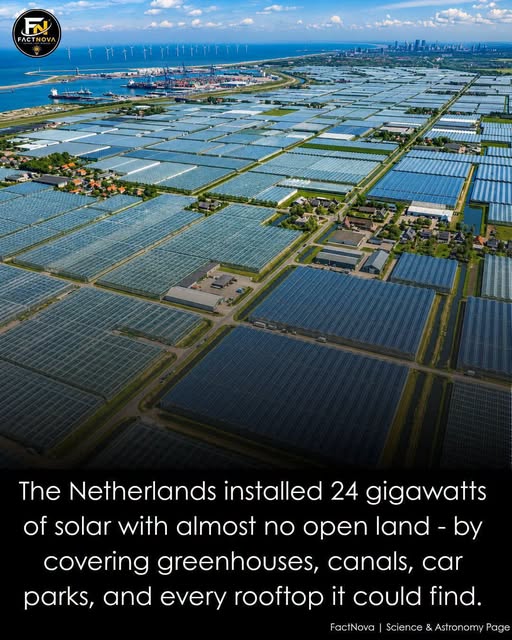
☀️🇳🇱 The Netherlands Is Putting Solar Panels in Places You’d Never Expect
The Netherlands has a problem that many countries are beginning to face: there simply isn’t much spare land.
It’s a densely populated country with valuable farmland, busy cities, waterways, roads, and protected natural areas. So instead of covering enormous stretches of open countryside with solar panels, the Dutch have been finding a much smarter solution.
Use the spaces that already exist. ⚡
Across the country, solar panels are appearing on greenhouses, rooftops, car parks, and even canals.
The idea is surprisingly simple: if a surface is already being used, why not make it generate electricity too?
🌱 Turning Existing Spaces Into Power Plants
Dutch greenhouses, for example, already occupy significant areas of land for agriculture. Adding solar panels to suitable structures can allow the same general footprint to contribute to electricity production.
Then there are rooftops.
Homes, warehouses, factories, schools, and commercial buildings all have something in common: large surfaces that sit beneath the sun every day.
Instead of requiring new land, solar technology can turn those surfaces into miniature power stations. ☀️🔋
Car parks offer another opportunity.
Large parking areas need to exist regardless, so installing solar canopies above them can potentially provide shade for vehicles while producing electricity underneath.
And perhaps most surprising of all are the country’s waterways.
Solar installations can be placed on or alongside certain canals and other water surfaces, creating another opportunity to generate power without competing directly with farmland.
⚡ A Country Learning to Use Every Surface
The Netherlands has reached roughly 24 gigawatts of installed solar capacity, making solar an increasingly important part of its energy system.
But the most interesting lesson isn’t simply the number.
It’s the strategy behind it.
Rather than asking, “Where can we find more land for solar farms?”
The Netherlands is also asking:
“What surfaces are already here that could produce electricity?”
That small change in thinking can make a huge difference in a country where land is precious.
A roof doesn’t need to become a field.
A parking lot doesn’t need to disappear.
A greenhouse doesn’t have to stop being agricultural space.
Even a waterway can potentially contribute.
🌍 Could This Be the Future?
As countries around the world try to expand renewable energy while protecting farmland, forests, and natural habitats, the Dutch approach offers an intriguing idea:
Solar power doesn’t always need more land. Sometimes, it simply needs more imagination. 💡
The future of clean energy may not be about building bigger and bigger solar farms.
It may be about looking at the places we’ve already built—and realizing that many of them have been sitting under the sun all along.
☀️ Use the roof. Cover the parking lot. Share the greenhouse. Explore the water.
When space is limited, perhaps the smartest energy solution isn’t finding somewhere new to build.
It’s learning how to make better use of what we already have. 🇳🇱🌱⚡