🏙️💭 The Skyscraper Design That Looked Uncomfortably Like 9/11 — And Sparked an International Backlash
In 2011, a Dutch architecture firm unveiled plans for two spectacular luxury residential towers in Seoul, South Korea.
On paper, the concept sounded futuristic.
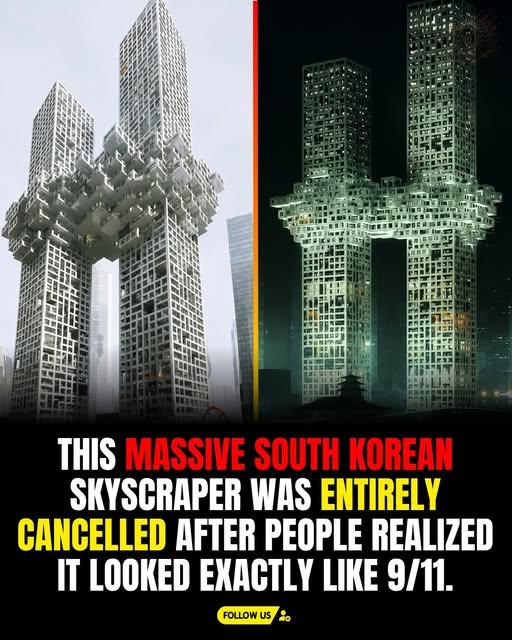
One tower was designed to rise 54 floors, while the other would reach 60 floors. Connecting the two near the upper levels was an enormous, cloud-like structure filled with planned amenities—including a swimming pool, restaurants, and sky lounges.
The architects called the project “The Cloud.”
But when images of the proposed buildings spread online, many people saw something completely different.
They saw September 11, 2001. 😔
☁️ When Architecture Became Controversy
The renderings showed two tall towers standing side by side, with a massive billowing structure stretching between them.
To many American viewers, the shape of that structure looked disturbingly similar to the cloud of smoke and debris surrounding the World Trade Center towers during the September 11 attacks.
The reaction was immediate.
Angry comments began appearing online, including on the architecture firm’s social-media pages. For people who had lived through 9/11 or lost loved ones that day, the resemblance was deeply upsetting.
What had been presented as an imaginative architectural concept suddenly became the center of an international controversy.
The firm, MVRDV, responded with a public apology.
They explained that creating an image resembling the attacks had never been their intention, and said they had not recognized the resemblance while developing the design.
They expressed regret to anyone whose feelings had been hurt by the images. 💔
🌍 A Difference in Perspective
What made the controversy even more complicated was the difference in how the design was perceived in different countries.
Reports from South Korea indicated that the connection to 9/11 was not immediately recognized there. Instead, the project had initially attracted attention for its unusual and innovative design.
That raised an uncomfortable question:
Can something be completely unintentional and still be deeply offensive?
For many critics, the answer was yes.
Others argued that the resemblance was simply an unfortunate coincidence created by the unusual form of the buildings.
There was also another detail that fueled the debate.
The proposed towers were planned near the redevelopment area associated with Seoul’s Yongsan district, while the comparison to the World Trade Center was further complicated by the broader cultural significance of Ground Zero and its redevelopment.
Suddenly, what might have been dismissed as an unfortunate visual coincidence became much harder for some observers to ignore.
🏗️ The Project That Never Became Reality
Initially, the South Korean developer indicated that the controversial design would not be changed.
But the international backlash continued.
Eventually, The Cloud was never built as originally envisioned.
The towers remained architectural renderings rather than becoming part of Seoul’s skyline.
And that may be why the story continues to resurface years later.
Architecture is supposed to provoke thought. It can challenge expectations, reshape skylines, and make people see familiar spaces differently.
But sometimes, an architect creates something that communicates a message they never intended.
And once that image exists, the meaning may no longer belong entirely to its creator.
Was The Cloud an unfortunate coincidence that happened to evoke one of the most painful images of modern history?
Or should the resemblance have been recognized before the renderings were released?
There may never be a universally accepted answer.
But the story remains a striking reminder that what an artist or architect intends isn’t always what the world sees. 🏙️☁️