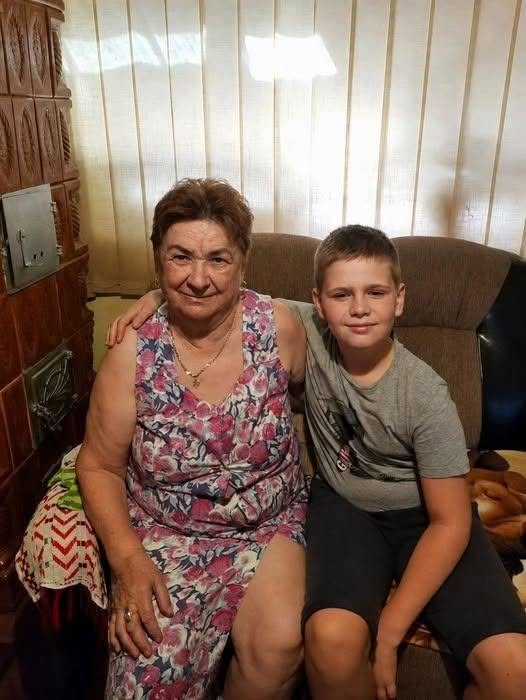
🚨👦 “My Grandma Ties My Hands Every Night.” When His Teacher Arrived With Police, She Froze at What She Saw
Seven-year-old Lucas said the words so calmly that, at first, his teacher didn’t understand how serious they were.
“My grandma ties my hands every night.”
Mrs. Carter stopped what she was doing.
“What did you say, Lucas?”
The little boy lowered his head and pulled his sleeves farther over his wrists.
“My grandma ties my hands every night.”
Mrs. Carter looked down.
Several red marks were visible beneath his sleeves.
Her heart sank.
“Why does she do that?”
Lucas glanced toward the classroom door.
He seemed afraid someone might hear him.
“She says something bad will happen if she doesn’t.”
“Does it hurt?”
Lucas was silent for a moment.
“Sometimes.”
Then he whispered:
“When I try to get free, Grandma holds me and tells me not to open my eyes.”
Mrs. Carter felt a chill run through her.
At that moment, she knew she couldn’t simply ask a few more questions and then send the boy home.
Something was wrong.
🧸 Lucas Hadn’t Always Been Like This
Lucas had been living with his grandmother, Margaret, for six months.
His parents had died in a tragic car accident, leaving Margaret as his only guardian.
At first, everyone assumed the elderly woman was simply doing her best to care for a grieving child.
But over the previous few weeks, Lucas had changed.
He frequently fell asleep during class.
He refused to sit near the windows.
And whenever someone accidentally touched his wrists, he would flinch.
Mrs. Carter remembered one conversation in particular.
She had once asked him why he was always so tired.
Lucas had answered:
“Grandma sits beside my bed at night and watches me.”
At the time, Mrs. Carter had thought Margaret was simply terrified of losing her grandson after losing her own child.
Now those words sounded very different.
That same day, the teacher reported everything to the principal.
The school contacted the appropriate child-protection authorities and police.
They decided to visit Margaret’s home that evening.
🌙 The Knock at Eleven O’Clock
When school ended, Margaret was waiting at the gates as usual.
She took Lucas firmly by the hand.
Mrs. Carter watched them leave.
The grandmother noticed the teacher staring.
“Did something happen?” Margaret asked nervously.
“No,” Mrs. Carter replied carefully. “Lucas just seems very tired today.”
Margaret looked down at the boy.
Fear appeared across her face.
“Last night was difficult again,” she whispered.
Mrs. Carter’s eyes narrowed.
“What was difficult?”
Margaret didn’t answer.
She simply took Lucas’s hand and hurried away.
That night, at approximately eleven o’clock, Mrs. Carter stood outside Margaret’s old house with police officers and a social worker.
The upstairs window was illuminated.
A shadow moved behind the curtain.
They knocked.
No answer.
They knocked again.
Still nothing.
Then came a heavy thud from inside.
A few seconds later, they heard Lucas scream.
“Grandma! Let me go!”
Mrs. Carter’s hands began trembling.
An officer stepped forward.
“Ma’am, open the door. Police!”
Footsteps rushed across the floor inside.
Something crashed.
Then Lucas shouted again.
“I want to get out!”
The officers didn’t wait any longer.
They entered the house and rushed upstairs.
Lucas’s bedroom door was locked.
One officer forced it open.
And everyone froze.
😨 “Please… Don’t Untie His Hands.”
Lucas was lying on the floor.
Soft fabric restraints were wrapped around his wrists.
Margaret was kneeling beside him, gripping his shoulders.
The bedroom window stood wide open.
“Step away from the child!” the officer ordered.
Margaret didn’t move.
“Please…”
Her voice was shaking.
“Please don’t untie his hands.”
“Let him go. Now.”
The social worker stepped toward the boy.
But Margaret suddenly cried out.
“He isn’t awake!”
Everyone stopped.
Mrs. Carter stared at Lucas.
The boy’s eyes were closed.
His breathing was shallow.
“What do you mean, he isn’t awake?” the teacher asked.
Margaret looked toward the open window.
Tears streamed down her face.
“You don’t understand,” she whispered.
“He gets up when he’s asleep.”
The room fell silent.
Margaret explained that Lucas had begun suffering from terrifying episodes after his parents’ death.
Several times, she had found him wandering through the house in the middle of the night without being fully conscious.
One night, he had opened the upstairs window.
Another night, she had found him standing at the top of the staircase.
She had been terrified that he would fall.
The restraints, she insisted, were never meant as punishment.
She believed they were the only way she could keep him from hurting himself while asleep.
But Margaret had made a terrible mistake.
Instead of seeking professional help, she had tried to handle the frightening situation alone.
And Lucas had been suffering because of it.
Mrs. Carter’s eyes filled with tears.
She looked at the frightened little boy and then at Margaret.
“You should have asked for help.”
Margaret broke down.
“I was afraid they’d take him away from me.”
The police and social worker carefully freed Lucas and immediately arranged for him to receive medical attention and protection.
For the first time in weeks, he was able to sleep somewhere safe.
And the truth became painfully clear:
Margaret hadn’t been hiding a monster in the house.
She had been a grieving grandmother who was terrified, overwhelmed, and completely unprepared to care for a child experiencing frightening nighttime episodes.
But good intentions don’t make dangerous actions safe.
Lucas needed protection.
Margaret needed help.
And sometimes, the bravest thing a caregiver can do isn’t trying to handle everything alone.
It’s admitting, “I can’t do this by myself.” ❤️