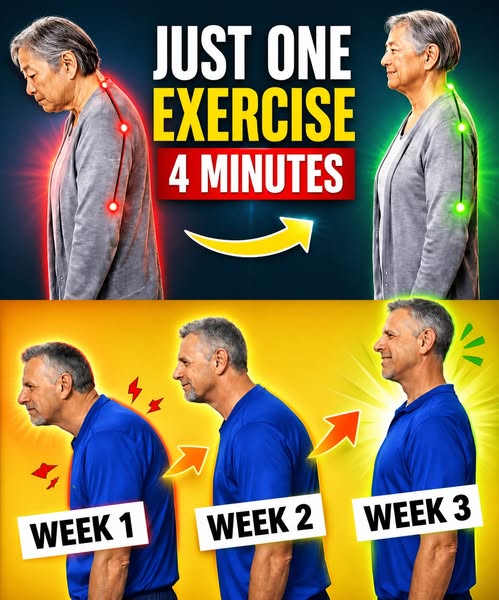
🧓🧘 How to Improve Forward Head Posture After 60 in Just 4 Minutes a Day — A Gentle Routine for Standing Taller and Moving Better
Have you noticed that your head seems to sit farther forward than it used to?
Maybe your shoulders round forward when you walk. Perhaps your neck feels stiff after looking down at your phone, reading, or watching television. Or maybe you catch your reflection and realize that your ears seem to sit noticeably in front of your shoulders.
You’re not alone.
This pattern is often called forward head posture, and it becomes increasingly common as we age.
The good news is that getting older doesn’t mean you have to simply accept worsening posture.
Research has found that therapeutic exercise can improve measurements of forward head posture and may also reduce neck pain.
And you don’t necessarily need an exhausting workout.
A few gentle movements performed consistently can be a useful place to start. ❤️
🧍 First: Understand What You’re Trying to Correct
Forward head posture occurs when the head rests farther forward relative to the trunk.
Instead of the head being comfortably balanced over the shoulders, the neck and upper back may have to work harder to support it.
Over time, this can contribute to neck discomfort, stiffness and reduced movement.
But posture isn’t simply a matter of “pushing your head backward.”
Your neck, upper back, chest and shoulder-blade muscles all contribute to how you hold yourself.
That’s why a combination of gentle mobility and strengthening exercises can be more useful than relying on one movement alone. Studies have found benefits from exercise programs that address posture and neck function rather than focusing on a single exercise.
⏱️ The Gentle 4-Minute Routine
Try these movements slowly and comfortably. Nothing should cause sharp pain, dizziness, numbness or tingling.
1️⃣ Gentle Neck Reset — 1 Minute
Sit upright in a sturdy chair.
Keep your shoulders relaxed.
Slowly turn your head to the right as far as comfortable.
Return to the center.
Then slowly turn toward the left.
Repeat several times.
Next, gently bring your chin toward your chest and return to neutral.
The goal isn’t to stretch aggressively.
It’s simply to remind your neck that it can move comfortably.
2️⃣ Gentle Chin Tuck — 1 Minute
Sit or stand tall.
Look straight ahead.
Without looking up or down, gently draw your chin backward—as though you’re making a very small “double chin.”
Hold for about 3–5 seconds.
Relax.
Repeat several times.
Think “lengthen the back of the neck”, not “force the head backward.”
This movement can help activate muscles involved in supporting the head and neck.
3️⃣ Shoulder-Blade Squeeze — 1 Minute
Sit or stand comfortably.
Let your arms rest by your sides.
Gently draw your shoulder blades back and slightly down.
Don’t shrug.
Don’t force your chest forward.
Hold for several seconds, then relax.
Repeat slowly.
Strengthening and coordinating the muscles around the shoulder blades can be an important part of improving overall posture. Research in people with forward head posture has examined combined neck and shoulder-focused approaches, with exercise generally showing benefits for posture and symptoms.
4️⃣ Gentle Upper-Back Stretch — 1 Minute
Sit in a chair with your feet supported.
Place your hands comfortably behind your head or across your chest.
Keep the movement small and controlled.
Gently allow your upper back to extend over the chair’s backrest while keeping your neck comfortable.
Return to your normal upright position.
Repeat several times.
This movement focuses on the thoracic spine, the upper portion of your back that can become stiff when we spend long periods sitting or looking downward.
🌿 The Secret Isn’t the Four Minutes
Four minutes can be a convenient starting point.
But four minutes once isn’t going to permanently change your posture.
The real benefit comes from consistency.
A recent systematic review found that exercise interventions can improve forward-head posture, neck pain and neck function, although the ideal exercise program and duration are still not completely established.
So instead of thinking:
“I need to fix my posture today.”
Think:
“I’m going to give my neck and upper back a little attention every day.”
You can also make small changes throughout the day:
📱 Hold your phone closer to eye level.
📖 Avoid spending long periods with your head bent downward.
🪑 Adjust your chair so you’re supported comfortably.
🚶 Get up and move regularly instead of remaining in one position for hours.
💪 Gradually build overall strength and mobility as your body allows.
These small habits may matter just as much as the few minutes of exercise.
❤️ And Remember: Gentle Is Better Than Aggressive
After 60, there’s no prize for forcing your neck into an extreme position.
You don’t need painful stretches.
You don’t need to yank your head backward.
And you don’t need to stand rigidly all day.
The goal is comfortable alignment, mobility, strength and confidence in movement.
If you have significant neck pain, numbness, weakness, balance problems, headaches associated with neck movement, or a recent injury, speak with a doctor or physical therapist before starting exercises.
Your posture doesn’t have to be perfect.
It simply needs to support the life you want to keep living.
Four gentle minutes can be a beginning—but consistency is what creates lasting change. 🌿