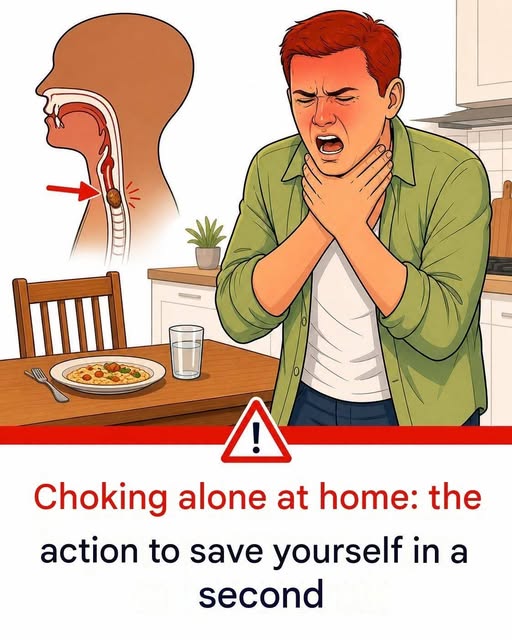
A Piece of Food Is Stuck and There’s No One Around: What to Do If You’re Choking 🚨
Few emergencies are more frightening than suddenly realizing you cannot breathe because food is stuck in your airway.
When you’re alone, the situation becomes even more terrifying. You can’t simply call for someone to perform abdominal thrusts or back blows.
So what can you actually do?
The most important thing is to act immediately. If you are able to cough forcefully, keep coughing. But if the airway is completely blocked and you cannot breathe, speak, or cough effectively, you need to attempt self-rescue.
🚨 First: Recognize Severe Choking
A person with a mild blockage may still be able to cough, speak, or breathe.
Severe choking is different.
You may be unable to:
- Breathe normally
- Speak or make sounds
- Cough effectively
- Get enough air
- Produce a normal voice
You may instinctively grab your throat or become increasingly panicked.
Don’t waste time trying to drink water or swallowing more food to “push it down.” A completely blocked airway is an emergency.
📞 Call Emergency Services Immediately
If you can still use your phone, call your local emergency number immediately.
If you’re unable to speak, leave the line open if possible so the dispatcher can hear what is happening.
If you have access to an emergency SOS feature on your phone or watch, activate it.
Then begin self-rescue.
🪑 Use a Firm Object for Abdominal Thrusts
If you’re alone and experiencing severe choking, one recognized first-aid technique is to perform abdominal thrusts on yourself.
Make a fist and place it just above your belly button and below your breastbone. Grasp the fist with your other hand.
Then thrust forcefully inward and upward.
If that doesn’t dislodge the object, repeat the thrusts.
Another option is to use the edge of a firm, non-sharp surface—such as the back of a sturdy chair or countertop.
Position your upper abdomen against the edge and deliver forceful inward and upward thrusts.
The goal is to create enough pressure inside the abdomen to force air upward through the airway and potentially dislodge the object.
❌ Don’t Perform a Blind Finger Sweep
One of the most important things to avoid is putting your fingers into your throat and blindly searching for the food.
If you can’t see the object, you could accidentally push it farther down.
Only remove an object if you can clearly see it and easily grasp it.
🫁 What If You Become Unconscious?
This is why calling emergency services as early as possible matters.
If the blockage isn’t relieved, you may lose consciousness because your brain and body aren’t receiving enough oxygen.
If you collapse, emergency responders need to reach you as quickly as possible.
If you regain consciousness after a choking episode, medical evaluation may still be appropriate, particularly if you have persistent coughing, breathing difficulties, chest pain, difficulty swallowing, or a sensation that something remains stuck.
👶 What About Children?
Self-rescue instructions for an adult should not simply be applied to infants or young children.
Choking first aid differs according to age and size. If a child or infant is choking, use age-appropriate first-aid guidance and contact emergency services immediately.
🧠 The Most Important Thing to Remember
When you’re choking alone, panic can make it harder to act.
Try to remember this sequence:
Severe choking → call for emergency help → attempt self-abdominal thrusts → repeat if necessary → don’t blindly put your fingers in your throat.
If you can cough effectively, keep coughing rather than immediately attempting thrusts.
And if you can breathe or speak, the airway isn’t completely blocked—though the situation can still deteriorate quickly.
❤️ Learn It Before You Need It
Choking emergencies don’t give you much time to think.
That’s why learning basic first aid before an emergency happens can make an enormous difference.
A certified first-aid or CPR course can teach you how to recognize choking and perform appropriate techniques safely for adults, children, and infants.
And if you ever find yourself alone with a completely blocked airway, remember:
Don’t freeze. Call for help, act quickly, and use the appropriate self-rescue technique. 🚨
This article is for general education and does not replace hands-on first-aid training. In a real choking emergency, contact your local emergency medical service immediately. If the person becomes unconscious, follow the emergency dispatcher’s instructions.