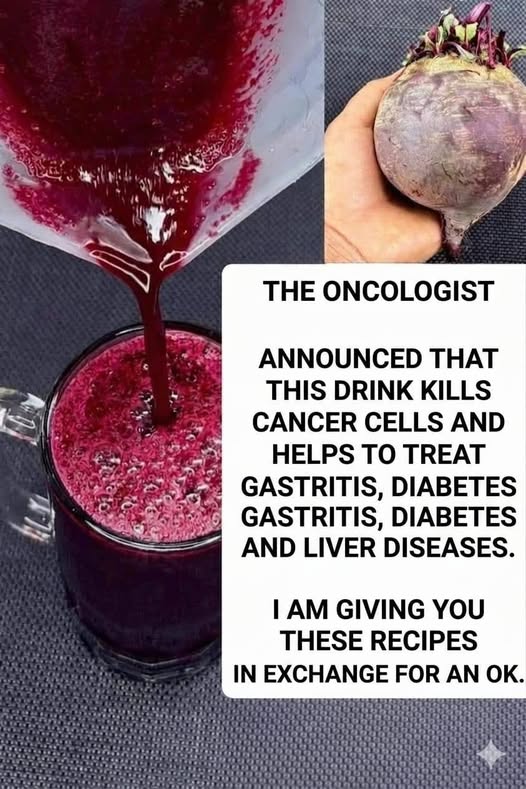
🚨 ALERT! Does Beetroot Juice Really Kill Cancer Cells in 42 Days? Here’s What the Science Says
You’ve probably seen the dramatic claim online:
“BEETROOT JUICE KILLS CANCER CELLS IN 42 DAYS!” 🍷🌿
It certainly sounds promising—but there is no good clinical evidence that drinking beetroot juice kills cancer cells in humans within 42 days.
That doesn’t mean beetroot is unhealthy. Quite the opposite. But there’s an important difference between a nutritious food and a proven cancer treatment.
🍠 Why Is Beetroot Getting So Much Attention?
Beetroot contains naturally occurring compounds called betalains, as well as nitrates and other antioxidants.
Researchers have investigated betalains because laboratory experiments have found that some beetroot compounds can interfere with cancer-cell growth and trigger processes associated with cancer-cell death. Recent reviews continue to describe these findings as promising—but largely preclinical evidence. (PubMed)
That’s where the viral claim appears to come from.
Researchers may observe an effect on cancer cells in a laboratory, but that doesn’t mean drinking beetroot juice produces the same effect inside a human body.
🔬 What Happens in the Laboratory?
Some studies have exposed cancer cells to beetroot extracts or purified compounds.
For example, research has reported effects on prostate and breast cancer cell lines, including reduced cell growth. (PubMed)
But these experiments involve controlled concentrations of specific compounds and aren’t equivalent to drinking a glass of beetroot juice.
A 2026 systematic review likewise concluded that more well-designed clinical trials are needed before betalains can be considered an established cancer treatment. (PubMed)
❌ What About the “42 Days” Claim?
There is no established scientific evidence showing that beetroot juice eliminates cancer cells in 42 days.
The claim has circulated widely online, but fact-checking found no clinical evidence supporting a fixed 42-day cancer-killing effect. (Africa Check)
And this is an important rule to remember:
If a food or drink is advertised as curing cancer within a specific number of days, be extremely skeptical.
Cancer isn’t one disease. Different cancers behave differently, and treatment depends on the type, stage, genetics, and individual circumstances.
🥤 Is Beetroot Juice Still Healthy?
It can certainly be part of a healthy diet.
The National Cancer Institute notes that beetroot juice contains compounds such as betacyanin and nitrates, and beetroot juice has been studied for effects including blood flow and blood pressure. (Cancer.gov)
So there’s nothing wrong with enjoying beetroot as a nutritious food unless your healthcare professional has advised you otherwise.
But it shouldn’t be presented as a substitute for cancer treatment.
🩺 If You Have Cancer, Don’t Replace Treatment
This is the most important point.
The NCI states that there is no proof that any particular food, diet, vitamin, supplement, herb, or combination can cure cancer or stop it from returning. (Cancer.gov)
Similarly, the National Center for Complementary and Integrative Health warns against using unproven approaches to replace or delay conventional cancer treatment. (NCCIH)
That means beetroot juice can potentially be part of your diet, but it shouldn’t replace chemotherapy, radiation, surgery, immunotherapy, targeted therapy, or other treatment recommended by your oncology team.
❤️ The Bottom Line
Beetroot is an interesting and nutritious vegetable, and its natural compounds are being actively studied for potential anticancer properties.
But “beetroot juice kills cancer cells in 42 days” is not an established medical fact.
🌿 Promising laboratory research is not the same as a proven cancer cure.
Enjoy beetroot for its nutritional value—but if cancer is involved, let evidence-based medical treatment lead the way. 🩺❤️