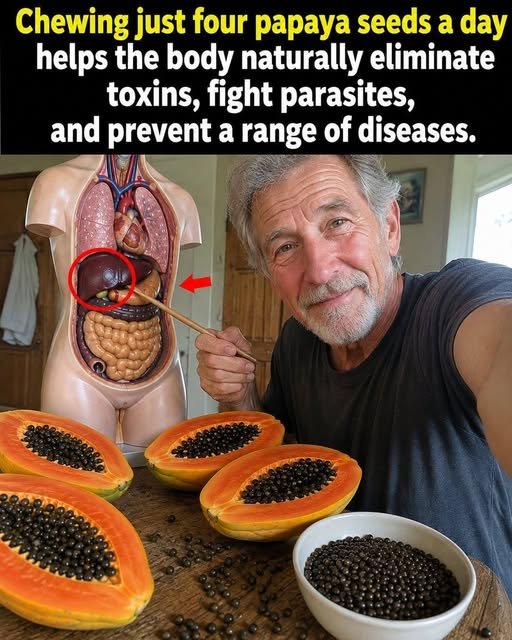
Papaya seeds come from Carica papaya and contain compounds such as polyphenols, flavonoids, benzyl isothiocyanate, fatty acids, and other phytochemicals. Laboratory research has found antioxidant and antimicrobial activity in papaya-seed extracts.
However, there is an important difference between:
“A compound shows an effect in a laboratory study”
and
“Eating four seeds every day produces that effect in humans.”
The second claim requires controlled human studies, and those are lacking.
1. Do papaya seeds “detox” the body?
There is no strong evidence that eating papaya seeds removes unspecified “toxins” from the body.
Your liver and kidneys are primarily responsible for processing and eliminating many substances, while the digestive tract, lungs and other systems also contribute to waste removal.
So, rather than saying:
“Papaya seeds naturally detox your body.”
A scientifically safer statement is:
“Papaya seeds contain antioxidant compounds that are being studied for their potential biological effects.”
2. Can they eliminate parasites?
This is where the claim has some scientific background, but it is often exaggerated online.
Some laboratory and animal research has investigated papaya seeds against intestinal parasites. There has also been limited human research involving papaya preparations.
That does not establish that eating four raw seeds daily reliably eliminates intestinal worms or other parasites.
If someone actually has a parasitic infection, the appropriate treatment depends on the specific parasite and should not be replaced with papaya seeds.
3. Can four seeds prevent diseases?
There is currently no reliable evidence showing that four papaya seeds per day prevent a broad range of diseases.
Papaya seeds contain potentially beneficial phytochemicals, but that doesn’t mean they have been proven to prevent:
- cancer
- diabetes
- heart disease
- infections
- liver disease
- intestinal parasites
- inflammatory diseases
Those would require substantial human clinical evidence.
4. What about inflammation?
Papaya seeds contain antioxidant and other bioactive compounds that have demonstrated biological activity in experimental research.
That makes them interesting for research into inflammation and oxidative stress.
But it would be inaccurate to tell people that eating four seeds daily is a proven anti-inflammatory treatment.
5. Are four seeds a day safe?
“Four” isn’t a scientifically established therapeutic dose.
The amount of papaya seeds used in research varies considerably depending on whether researchers are studying whole seeds, extracts, animals, or humans.
Also, concentrated extracts aren’t equivalent to eating a few raw seeds.
Large quantities of papaya seeds may cause digestive discomfort, and the safety of prolonged medicinal consumption hasn’t been adequately established.
Extra caution is appropriate during pregnancy, because safety data for medicinal/high-dose consumption are limited.
6. Why does the “four seeds a day” claim spread?
It sounds precise, which makes it appear scientific.
But a specific number doesn’t automatically mean there is a scientifically established dosage.
For example:
“Four seeds contain beneficial plant compounds”
is very different from:
“Four seeds eliminate toxins and prevent disease.”
The first can be discussed as a nutritional observation; the second is a medical claim requiring evidence.
Bottom line
Papaya seeds are edible and contain several interesting plant compounds. Preliminary research suggests possible antioxidant, antimicrobial and antiparasitic activity, but evidence in humans is insufficient to claim that eating four seeds daily detoxifies the body, eliminates parasites, reduces inflammation, or prevents diseases.