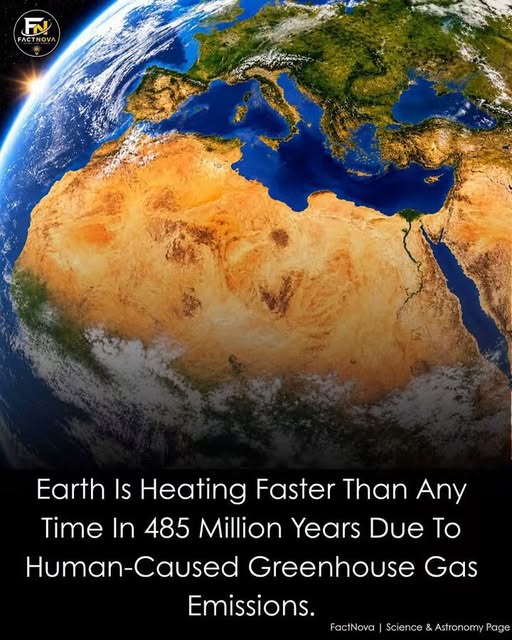
🌍🔥 Earth Is Warming at an Extraordinary Pace — And Humans Are Driving It
Earth’s climate has never been completely static.
Throughout its long history, the planet has experienced ice ages, warmer periods, volcanic eruptions, and dramatic shifts in atmospheric conditions. But today’s warming stands out for one crucial reason:
The speed at which it is happening.
Over the past century, human activities have released enormous quantities of carbon dioxide, methane, and other greenhouse gases into the atmosphere.
These gases act like a heat-trapping blanket around the planet.
☀️ How Greenhouse Gases Warm the Planet
When sunlight reaches Earth, the surface absorbs much of its energy and later releases some of that energy back toward space as infrared radiation.
Greenhouse gases interfere with that process.
Carbon dioxide, methane, and other gases absorb and re-emit some of the outgoing infrared energy, keeping more heat within the Earth system.
The result is a warming planet.
And because humans have dramatically increased the concentration of these gases, the natural balance has been pushed in a new direction.
🧊 The Planet Is Showing the Effects
The consequences aren’t limited to a thermometer reading.
A warming climate affects interconnected parts of the Earth system.
Glaciers and ice sheets are losing mass.
🌊 Sea levels are rising.
🔥 Extreme heat is becoming more dangerous.
🌧️ Rainfall patterns are changing.
🌪️ Some types of extreme weather are becoming more likely or more intense in a warming world.
These changes don’t happen independently.
The climate system connects oceans, atmosphere, land, ice, and living ecosystems, meaning changes in one part can influence many others.
⏳ Why the Speed Matters
Earth has experienced major climate changes before.
But many of those natural changes unfolded over thousands or millions of years.
Modern warming is occurring over decades to centuries, largely because humans are rapidly adding greenhouse gases to the atmosphere.
That difference in pace matters enormously.
Plants, animals, ecosystems, infrastructure, agriculture, and human societies all have varying abilities to adapt to environmental changes.
When conditions shift rapidly, adaptation becomes much more difficult.
🌱 What Happens Next Depends on What We Do
The good news is that the future isn’t completely predetermined.
The amount of additional warming Earth experiences depends heavily on how much more greenhouse gas humanity releases.
Reducing emissions of carbon dioxide, methane, and other greenhouse gases can limit future warming and reduce the severity of many climate impacts.
That means climate action isn’t about returning Earth to some perfectly unchanged state.
It’s about reducing how much further the planet’s climate is pushed away from the conditions on which modern ecosystems and societies developed.
🌍 One Atmosphere. One Planet.
The atmosphere may seem enormous, but it is remarkably sensitive to what we put into it.
Every tonne of greenhouse gas added to the atmosphere becomes part of a global system that affects oceans, forests, ice, weather, wildlife, and communities around the world.
Earth has survived enormous changes throughout its history.
But the question facing humanity isn’t whether the planet itself will survive.
It will.
The real question is:
How much change will we allow to happen—and how difficult will that change make life for the billions of people and countless species that depend on today’s climate?
The choices made now can influence that answer for generations to come. 🌎💚