♻️🏠 Everyone Thought He Was Crazy for Collecting Thousands of Plastic Bottles—Then He Started Building Houses With Them
At first, people probably wondered what he was doing.
Why would anyone collect thousands of empty plastic bottles?
But Tateh Lehbib Breica had a plan.
And what looked like a strange habit eventually became an ingenious attempt to protect vulnerable families living in one of the world’s harshest environments. 🌵☀️
🌍 Building a Home Where Traditional Houses Struggled
Tateh grew up in a Sahrawi refugee camp in the Algerian desert.
Life there could be incredibly difficult.
Families faced extreme heat, powerful sandstorms, and occasional heavy floods capable of damaging or destroying traditional mud-brick homes.
For many families, rebuilding after severe weather was a constant challenge.
After studying renewable energy and energy efficiency, Tateh began thinking about an unconventional solution.
Instead of seeing discarded plastic bottles as worthless waste, he saw them as potential building material.
🧴 From Trash to Building Blocks
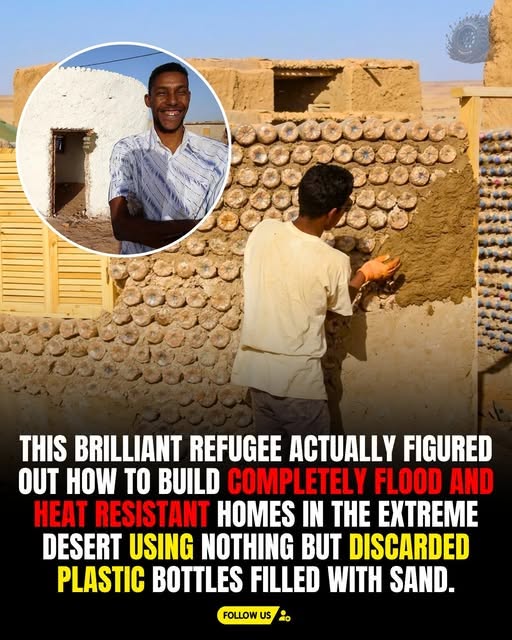
Tateh began filling empty plastic bottles with sand.
Then he started using them like bricks.
The idea sounded unusual—but it was surprisingly practical.
The bottles could be packed tightly together and arranged to form thick walls. The structures could then be covered and insulated, creating homes better suited to the extreme desert environment.
His first project had a deeply personal purpose:
He wanted to build a new home for his grandmother. ❤️
Her previous home had been damaged by flooding, leaving her vulnerable to another disaster.
So Tateh gathered his bottles, filled them with sand, and started building.
🏠 Why the Houses Were Different
The homes weren’t simply piles of bottles.
Their design was carefully adapted to the environment.
The structures were built with thick, rounded walls, giving them a distinctive circular appearance.
That shape helped the buildings cope with strong desert winds and sandstorms while also reducing some of the effects of the intense sunlight.
The construction approach also proved more resistant to heavy rain than many traditional adobe structures in the camps.
What began as an experiment became a potential alternative for people who needed stronger, more resilient shelter.
♻️ One Idea Became Something Bigger
The most remarkable part of Tateh’s story is that he didn’t stop after building one house.
His grandmother’s home became proof that the idea could work.
Eventually, the project expanded, with bottle-based homes being built for other vulnerable families in the refugee camps.
Thousands of discarded containers that might otherwise have ended up as waste were given another purpose.
And a young engineer’s unusual idea became a symbol of resourcefulness, resilience, and hope. 🌱
💡 Sometimes the Answer Is Hiding in the Waste
Tateh’s story isn’t simply about building houses from plastic bottles.
It’s about looking at a problem differently.
Where others saw trash, he saw building material.
Where others saw an impossible environment, he saw an opportunity to innovate.
And where families faced repeated destruction from harsh weather, he tried to create something more resilient.
Sometimes the most extraordinary solutions don’t begin with expensive technology or unlimited resources.
Sometimes they begin with something everyone else has thrown away.
One bottle.
One idea.
One determined person.
And eventually, a home. ♻️🏠❤️