I Found This Strange Object and Had Absolutely No Idea What It Was — The Answer Turned Out to Be Surprisingly Simple
I found it sitting in a drawer I hadn’t opened in years.
At first, I honestly couldn’t figure out what I was looking at.
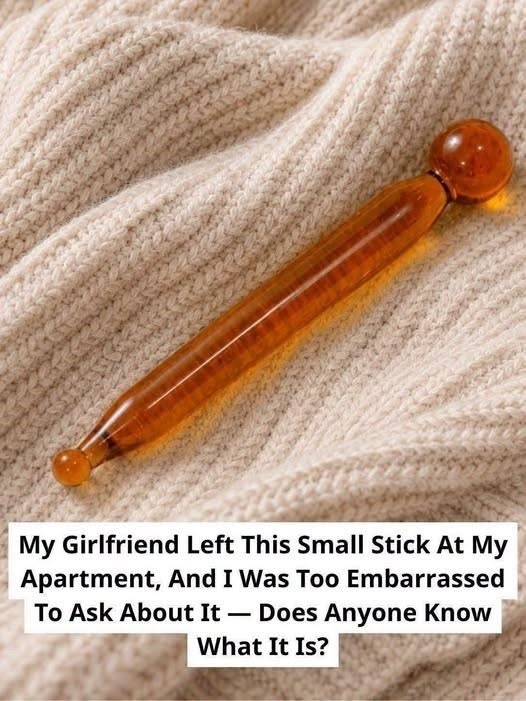
It was small, smooth, and oddly shaped. There were no buttons, no obvious moving parts, and nothing about it immediately suggested what it was supposed to do.
I turned it over several times.
Nothing.
I held it closer to the light.
Still nothing.
Naturally, my imagination started working overtime.
Was it an old household tool?
Something from a sewing kit?
A beauty product?
Maybe some kind of medical instrument?
The more I looked at it, the more mysterious it became.
So I did what anyone with an internet connection and too much curiosity would do.
I started searching.
And eventually, the answer appeared.
It was a vintage sewing stiletto.
Suddenly, the strange little object made perfect sense.
So What Is a Sewing Stiletto?
A sewing stiletto is a small pointed tool traditionally used in sewing and fabric work.
It isn’t a knife.
It isn’t a needle.
And despite its name, it has nothing to do with a shoe.
Instead, it was designed to help manipulate fabric with precision.
A seamstress could use the pointed end to help position fabric, open small holes, separate threads, or guide material while working on detailed sewing projects.
It could be particularly useful when working with tiny folds, decorative stitching, lace, or other delicate materials.
The tool was simple—but extremely practical.
Why Would Someone Need One?
Think about sewing before many of the conveniences we take for granted today.
A person working with fabric often needed several small tools within reach.
Scissors.
Pins.
Needles.
Thread.
And a stiletto.
The pointed tool could help with tasks that would otherwise be surprisingly difficult to accomplish with fingers alone.
It also allowed someone to manipulate fabric without putting their fingers directly next to a sewing-machine needle.
What looked completely mysterious to me was probably an ordinary part of someone’s sewing routine decades ago.
The Funny Thing About Old Objects
That’s what fascinates me about objects from previous generations.
Something can look completely meaningless to us simply because the activity it was designed for isn’t part of our everyday lives anymore.
Our grandparents didn’t need instruction manuals for many of these things.
They simply knew.
They knew what the object was called.
They knew where it belonged.
And they knew exactly how to use it.
Today, we can look at the same object and wonder whether it came from another planet.
A Tiny Piece of History
Once I knew what the object was, I couldn’t help looking at it differently.
It wasn’t strange anymore.
It was a reminder of how much everyday life has changed.
People used to repair clothing instead of immediately replacing it.
They spent hours sewing, altering, patching, and creating garments.
Small tools like this weren’t curiosities.
They were part of ordinary household life.
And that’s probably why finding one today can feel so mysterious.
The object survived.
The knowledge surrounding it didn’t always survive with it.
Maybe That’s the Real Mystery
The most interesting thing wasn’t actually figuring out what the object was.
It was realizing how quickly everyday knowledge can disappear.
A tool that was once completely familiar can become unrecognizable within a generation or two.
That’s why old drawers, sewing boxes, workshops, and kitchen cupboards can contain fascinating little pieces of history.
You might think you’ve found junk.
But sometimes you’ve found a tool that tells you something about how people once lived.
And sometimes, all it takes is a little curiosity to uncover the answer.
What looks like a strange object today may have been an everyday necessity to someone yesterday. (futurem.art)