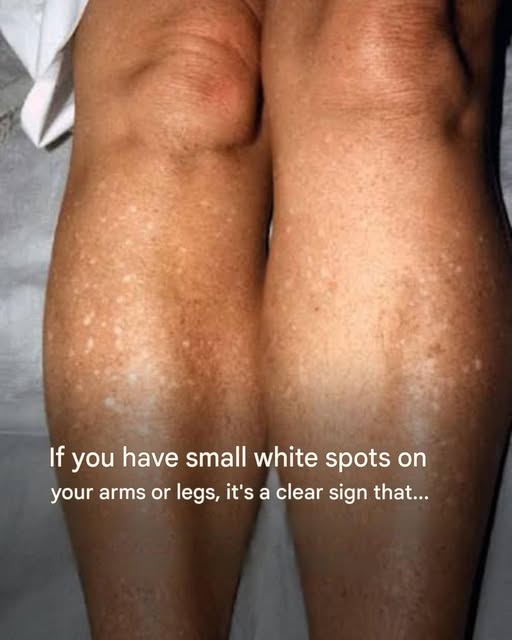
If You Have Small White Spots on Your Arms or Legs, It’s a Clear Sign That…
Small white spots on your arms or legs can be surprisingly noticeable, especially when they appear gradually and seem to become more visible in summer.
But contrary to many viral health posts, white spots are not a “clear sign” of one particular disease or vitamin deficiency. Several different skin conditions can cause them, and their appearance, texture, location, and whether they change over time can provide important clues.
One common cause: idiopathic guttate hypomelanosis
Tiny, flat, pale-white spots that commonly appear on the forearms and lower legs—particularly in middle-aged and older adults—can be idiopathic guttate hypomelanosis (IGH).
IGH is generally harmless. The spots are usually small, smooth, and lighter than the surrounding skin. Long-term sun exposure may play a role, which is why the spots can become more noticeable on sun-exposed areas.
Other possibilities
White or lighter patches can also occur because of:
- Vitiligo, an autoimmune condition that can cause more clearly defined areas of pigment loss.
- Fungal infections such as tinea versicolor, which may produce lighter or darker patches and sometimes fine scaling.
- Post-inflammatory hypopigmentation, which can develop after eczema, irritation, injury, or another skin inflammation.
- Scarring or other pigmentary conditions.
- Less commonly, certain nutritional or systemic problems can be associated with changes in skin appearance—but a few white spots alone aren’t enough to establish that explanation.
Look at the details
Pay attention to whether the spots are:
Flat or raised?
Smooth or scaly?
Increasing in number or size?
Completely white or simply lighter than your normal skin?
Itchy, painful, or otherwise changing?
These details can help a dermatologist distinguish between different causes.
When should you get them checked?
Consider seeing a healthcare professional if the spots are new and spreading, becoming sharply defined, associated with scaling or inflammation, affecting other parts of the body, or accompanied by other unusual symptoms.
And don’t automatically start taking vitamins or applying bleaching, steroid, or antifungal creams simply because you saw a social-media claim. Treatment depends on the actual cause.
The bottom line: small white spots aren’t a reliable “clear sign” that your body is deficient in something. Often they’re benign pigment changes, but persistent or changing patches deserve an accurate diagnosis rather than guesswork.