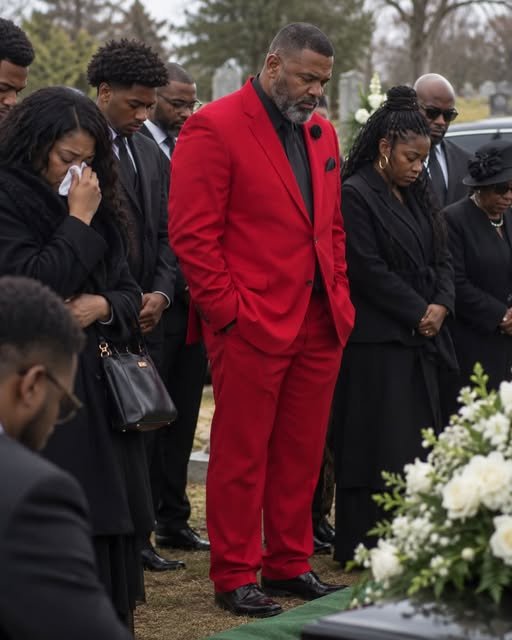
My brother stared at the envelope in his hands.
He didn’t open it.
Neither did I.
For several seconds, the three of us just stood there behind the yew tree while the rest of our family gathered around our father’s grave.
Then my brother looked at the solicitor.
“What did Dad know?”
The solicitor swallowed.
“I don’t know everything.”
“You knew about this.”
“I knew your father was hiding something.”
“That isn’t what I asked.”
The solicitor looked at me.
Then back at my brother.
“Your father came to my office eleven months ago.”
I felt my stomach tighten.
“Eleven months?”
He nodded.
“He told me he had made a mistake years ago. A very serious one. And he believed someone might eventually try to correct that mistake for him.”
My brother finally looked down at the envelope.
“What kind of mistake?”
The solicitor shook his head.
“That’s in the letter.”
My brother tore it open.
There was only one sheet of paper inside.
He read the first line.
Then stopped.
His face changed.
“What?”
He didn’t answer.
I took the letter from him.
At the top, in our father’s handwriting, were six words:
For my sons, when I’m gone.
Underneath was a date.
March 14.
The same date our father had supposedly suffered his first fall.
I read on.
If you are reading this, then the red suit has been found.
That means I was right about one thing.
Neither of you would have looked for it unless I made you uncomfortable enough to ask why it existed.
I looked at my brother.
He was staring at the ground.
Our father continued:
The suit is not important.
What is inside it is.
I turned the page.
There was another paragraph.
Twenty-seven years ago, I was given something that did not belong to me.
My heart began pounding.
Twenty-seven years.
That was before my brother was born.
Before my parents had moved into the house.
Before any of us knew the solicitor.
I read the next line.
I was afraid of what would happen if I returned it.
My brother whispered, “Returned what?”
I kept reading.
So I buried the truth instead.
There was a long pause in the letter.
Then:
I told myself I was protecting my family.
I wasn’t.
The solicitor quietly said, “Keep going.”
I looked at him.
“You knew this?”
“Not the details.”
I continued.
Your mother knew part of it.
That sentence made my brother step back.
“Our mother?”
I nodded slowly.
The letter went on.
She begged me to destroy the documents.
I couldn’t.
Years later, she asked me to promise that neither of you would ever learn what happened.
I lowered the page.
My brother looked at me.
“Why would Mum want us not to know?”
The solicitor didn’t answer.
I started reading again.
There is a second envelope.
Do not open it until you understand why the first document exists.
My eyes moved to the stiff envelope we’d found sewn into the jacket.
I looked at the solicitor.
“What’s in the second envelope?”
He said nothing.
My brother held it up.
“Dad specifically said we weren’t supposed to open this yet.”
The solicitor nodded.
“Yes.”
“Then why did you give it to us?”
“Because the condition has been met.”
“What condition?”
He looked toward the cemetery.
Then he said something that made both of us go silent.
“Your father didn’t leave the red suit there for either of you.”
My brother frowned.
“Then who was it for?”
The solicitor’s eyes settled on me.
“You.”
I actually laughed.
Not because anything was funny.
Because it was impossible.
“Me?”
He nodded.
“Your father told me that if your brother found the suit first, I was to let him wear it.”
“Why?”
“Because you would stop him.”
I stared at him.
“And then?”
“Then I was supposed to tell you what I’m telling you now.”
He reached into his briefcase again.
This time he pulled out a photograph.
It was old.
Very old.
He handed it to me.
I looked down.
And nearly dropped it.
It showed my father standing outside a courthouse.
Beside him was a woman I’d never seen before.
But that wasn’t what terrified me.
There was a baby in the woman’s arms.
A baby wrapped in a white blanket.
On the back of the photograph, my father’s handwriting said:
The day I brought my second son home.
I looked at my brother.
He was pale.
“That’s impossible,” he said.
The solicitor quietly replied:
“No.”
He pointed at the photograph.
“That’s your brother.”
My brother stared at the baby.
Then at our father.
Then at me.
“But I’m not adopted.”
The solicitor’s voice dropped.
“No.”
He looked at the sealed envelope.
“You aren’t.”
My brother’s hands began shaking.
“Then who is that?”
The solicitor took a breath.
“That is the question your father spent twenty-seven years trying to answer.”
And then, from somewhere behind us, a woman’s voice said:
“Don’t open that envelope.”
We all turned.
My aunt was standing beside the yew tree.
She was crying.
And she was holding something in her hand.
Something that looked exactly like the missing key to my father’s locked study.