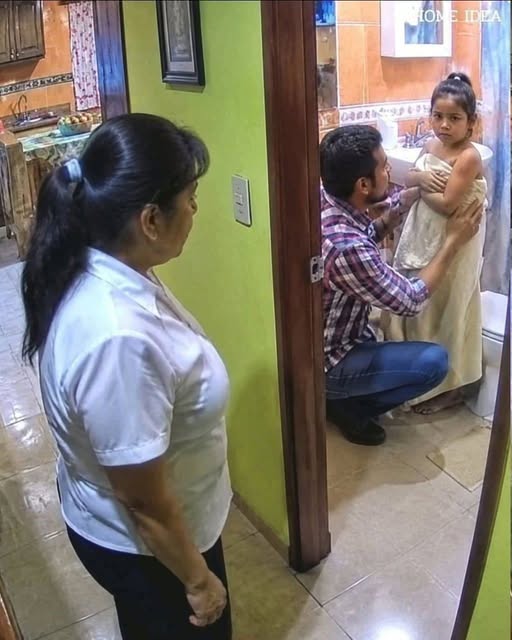
💔 A Mother Came Home Early—and What She Saw Changed Everything
At first, I told myself I was imagining things.
In the quiet neighborhoods of Guadalajara, where families often keep their struggles behind closed doors, I wanted desperately to believe that everything in our home was fine.
I had remarried because I wanted my five-year-old daughter, Sofía, and me to have a stable family again.
Her stepfather, Alejandro, seemed like the kind of man I could trust.
He was calm. Patient. Attentive.
Every evening, he offered to help with Sofía’s bedtime routine while I worked long hours at my small shop.
“I’ll take care of her,” he would say. “Children need to feel safe.”
And I believed him.
For a while.
Then my daughter began to change.
Sofía had always been cheerful and curious. She loved cartoons, told me endless stories about school, and ran toward me whenever I came home.
But slowly, that little girl seemed to disappear.
She became quieter.
She stopped telling me about her day.
She no longer laughed as freely.
And whenever Alejandro was nearby, she seemed especially withdrawn.
At first, I blamed myself.
Maybe she was adjusting to our new family.
Maybe she was tired.
Maybe I was simply worrying too much.
Then I noticed the bruises.
Small marks appeared on her arms and knees.
Later, I noticed one on her back.
I asked her how she had gotten them.
She wouldn’t answer.
One evening, I sat beside her on her little bed and held her hand.
“Are you okay, sweetheart?”
She nodded.
But her eyes filled with tears.
I asked again.
This time, she whispered that children at school sometimes pushed her and called her weak.
Then she said something that made my stomach tighten.
“Uncle Alejandro says it’s okay.”
I didn’t understand.
What did she mean?
Why would an adult tell a five-year-old that being hurt was okay?
That night, I couldn’t sleep.
Something inside me told me that I had been looking at individual details instead of seeing the whole picture.
My daughter’s silence.
Her sudden change in behavior.
The bruises.
Her fear.
I knew I couldn’t ignore it anymore.
So the following afternoon, I closed my shop earlier than usual and went home without telling anyone.
I wanted to see what was happening when no one knew I was coming.
The house was strangely quiet.
There was no television playing.
No music.
No laughter.
Then I heard water running from the bathroom.
I walked down the hallway.
The bathroom door was slightly open.
A strip of light spilled across the floor.
My heart began pounding.
I approached slowly.
And when I looked through the opening, I saw Alejandro with Sofía.
I froze.
I won’t describe what happened next.
Some moments don’t need graphic details to be horrifying.
What mattered was what I saw in my daughter’s face.
Fear.
The kind of fear no five-year-old should ever have to carry.
And suddenly, every warning sign I had dismissed came rushing back.
The silence.
The bruises.
The changes.
The things she couldn’t explain.
I realized then that this wasn’t something I could rationalize away.
It wasn’t something I could quietly confront and hope would disappear.
My daughter needed protection.
Immediately.
I stepped back from the doorway, took my phone, and contacted the people who could help.
From that moment forward, my priority was no longer preserving a marriage or protecting anyone’s reputation.
It was protecting my child.
Sofía deserved to grow up knowing that adults were supposed to keep her safe—not make her afraid.
She deserved to know that if something felt wrong, she could speak.
And most importantly, she deserved to know that none of what had happened was her fault.
That day changed our family forever.
It also taught me something I will never forget:
Sometimes children don’t have the words to explain what is happening to them.
But their behavior can speak.
Their silence can speak.
Their fear can speak.
And when a child suddenly changes, we should never be too quick to dismiss it.
A parent’s greatest responsibility isn’t believing that everything is fine.
It’s being brave enough to find out when something isn’t.
And sometimes, listening closely can be the difference between a child remaining trapped in fear and finally feeling safe again. ❤️