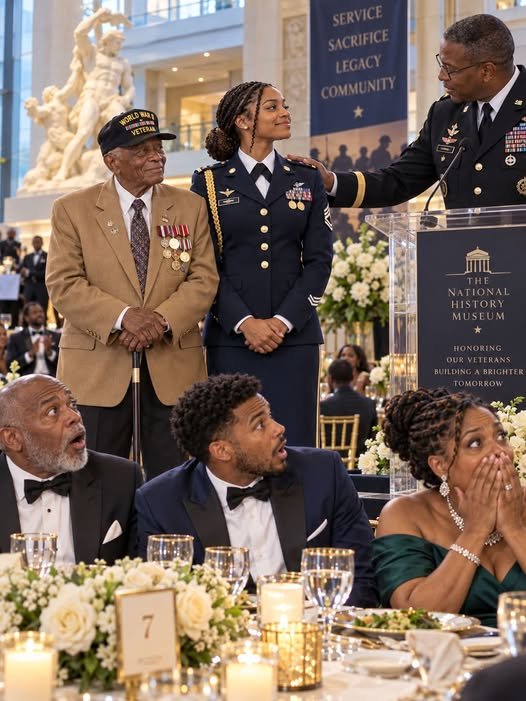
Part 2 — Today We Honour Two Soldiers
The ballroom went completely silent.
The general stood beneath the lights with one hand resting against the podium.
She looked toward the back row again.
Straight at me.
“Would Staff Sergeant Elena Hayes please come forward?”
My brother stopped moving.
My father turned around.
My mother finally looked up.
For a second, nobody seemed to understand.
Then my sister-in-law whispered:
“She’s talking about you.”
I stood.
The chair scraped against the floor.
Every head in the ballroom turned.
I could hear my own heartbeat.
I adjusted my uniform jacket, picked up my cap, and started walking.
As I passed the first row, I saw my brother’s face.
The confidence was gone.
He looked at me as if he were seeing a stranger.
I reached the stage.
The general stepped away from the microphone and came toward me.
Then she did something that made my father’s expression change completely.
She saluted me.
I returned the salute.
The ballroom erupted in applause.
Not polite applause.
The kind that fills the room.
The general turned toward the audience.
“Staff Sergeant Hayes served three deployments.”
My brother’s eyes widened.
“She was part of a medical evacuation team during her first deployment.”
My mother covered her mouth.
“She later volunteered for a second deployment when her unit was short-handed.”
The applause stopped.
Everyone was listening.
“And during her third deployment, she was awarded the Bronze Star with Valor.”
My father’s face went completely still.
Nobody at our table moved.
The general continued.
“Her grandfather served in Korea.”
She looked at the portrait hanging behind the stage.
“He came home and rarely spoke about what he had seen.”
Then she looked at me.
“Apparently, that trait runs in the family.”
A few people laughed softly.
I didn’t.
Because my grandfather had taught me something when I was little.
He told me that soldiers didn’t serve because they wanted people to clap for them.
They served because somebody had to stand there when everyone else wanted to go home.
The general stepped closer.
“Your grandfather once wrote a letter to his commanding officer saying that his proudest hope was that the next generation would never have to experience what his generation did.”
She paused.
“He didn’t know his granddaughter would spend eleven years trying to make that hope mean something.”
My throat tightened.
Then she handed me a small black box.
“On behalf of the service, and on behalf of the men and women who served beside you…”
She opened it.
Inside was my grandfather’s old unit insignia.
The one I thought had been lost years ago.
I stared at it.
“I thought this was gone.”
The general smiled.
“Your grandfather’s commanding officer kept it.”
I couldn’t speak.
Then I heard a chair move behind me.
My brother.
He had stood up.
“Excuse me,” he said.
Nobody answered.
He looked toward the general.
Then at me.
“You never told us.”
I looked at him.
“You never asked.”
He lowered his eyes.
My father finally stood.
“Why didn’t you tell us about the medal?”
I almost smiled.
Because suddenly the answer was painfully simple.
“You told me not to make my service my whole personality.”
He flinched.
“You told me people weren’t interested.”
My mother started crying.
“I didn’t mean—”
“I know.”
I looked at her.
“You didn’t mean to hurt me.”
She couldn’t meet my eyes.
“But you did.”
The general stepped back toward the microphone.
“There is one more thing.”
Everyone looked up.
She pointed toward the two tables where the executives and donors were seated.
“Mr. Bennett?”
The chief executive my brother had spent the afternoon trying to impress stood up.
“Yes, General?”
She smiled.
“Would you please come forward?”
He looked confused.
He walked toward the stage.
Then he turned to me.
“Staff Sergeant Hayes?”
I nodded.
He smiled.
“I’ve been trying to meet you for six months.”
My brother looked like someone had punched him.
The executive continued.
“Your work with military logistics and veteran transition programs is the reason our company was able to secure the government contract we announced last month.”
My father stared at him.
“But…”
The executive looked toward my brother.
“Your brother mentioned that you knew the family.”
My brother swallowed.
“I do.”
The executive nodded.
“Then you may want to congratulate her.”
He turned to the room.
“She’s joining our national advisory board.”
The ballroom erupted again.
But this time, I barely heard the applause.
I was looking at my father.
For years, he had told everyone my brother was the successful one.
The businessman.
The impressive one.
The one who had made something of himself.
And now he was sitting there realizing that the daughter he had been embarrassed to introduce was the person the people in this room had been waiting to meet.
My brother walked toward me after the ceremony.
For a moment, neither of us spoke.
Then he said quietly:
“I was wrong about you.”
I looked at him.
“No.”
He frowned.
“You weren’t wrong about me.”
I picked up my cap.
“You just never knew me.”
And for the first time in eleven years, I walked back toward my family table wearing my uniform.
Nobody asked me to take it off.