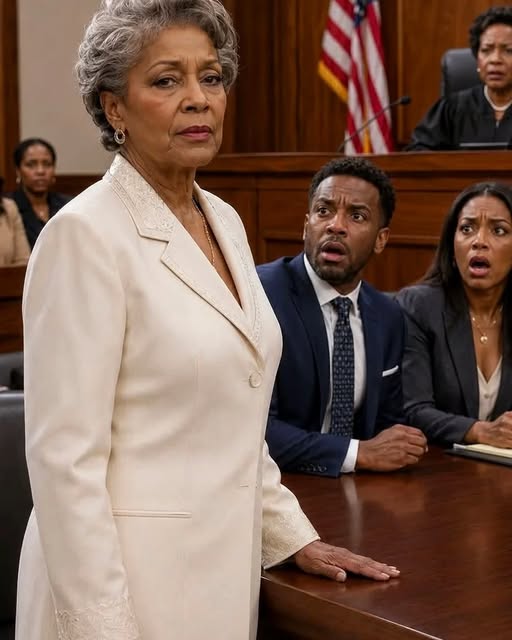
My Son and Daughter-in-Law Laughed When I Entered the Courtroom—They Thought I Was a Confused 71-Year-Old Woman
My son and daughter-in-law laughed the moment I entered the courtroom.
“Ha-ha,” Ethan whispered. “Now we’re going to leave her with nothing.”
They thought I was a confused seventy-one-year-old woman who had arrived without a lawyer.
They thought I was frightened.
Helpless.
Easy to manipulate.
They were about to discover how badly they had underestimated me.
“She’s Too Old to Manage Her Own Affairs”
The moment Ethan laughed, I knew my son had forgotten who taught him how to recognize a lie.
He leaned toward his wife, Celeste, and spoke loudly enough for several people nearby to hear.
“Ha-ha, now we’re going to leave her with nothing.”
Celeste covered her mouth as though embarrassed.
But I could see the satisfaction in her eyes.
I walked past them in a plain navy coat.
No handbag.
No attorney.
No expression they could read.
At seventy-one, with silver hair and a cane I mainly used on stairs, I looked exactly like the helpless woman they had described in their petition.
Confused.
Frail.
Unable to manage my own finances.
That was the story they had sold to the court.
They were asking for emergency guardianship over me.
Control of my bank accounts.
Authority to make financial decisions on my behalf.
And permission to sell the Westmere house my husband and I had built forty years earlier.
According to their petition, I had become “dangerously forgetful” after my husband’s death.
According to reality, something very different had happened.
Ethan had emptied my emergency account.
He had placed my signature on a loan application without my permission.
And he had moved Celeste’s brother into my guesthouse without asking.
When I objected, Celeste had smiled across my kitchen table.
“You should be grateful,” she told me.
“Most women your age would love having family handle everything.”
Ethan said nothing.
He wouldn’t even look at me.
The House They Thought They Owned
Three weeks later, they changed the locks.
My own son changed the locks to my own house.
I spent that night in a motel.
At midnight, Ethan sent me a message.
Stop making this difficult.
He had always confused my patience with surrender.
My grief had simply made that easier for him to believe.
The next morning, I made one phone call.
Not to Ethan.
Not to Celeste.
Not to the police.
I called the courthouse.
And I asked for the case file.
Because there was something Ethan had never bothered to learn about his mother.
I had spent my entire professional life studying people exactly like him.
The Woman They Thought Was “Just a Bookkeeper”
Their attorney, Grant Pierce, stood as I approached the respondent’s table.
“Mrs. Holloway appears without counsel,” he announced.
He turned toward the judge.
“Which further demonstrates her inability to understand the seriousness of these proceedings.”
Ethan smirked.
Celeste smiled.
I said nothing.
Then the judge entered.
Everyone stood.
Judge Nolan Whitmore adjusted his glasses.
He glanced through the file.
Then he looked toward me.
His expression immediately changed.
“Mrs. Margaret Holloway?”
I inclined my head.
“Good morning, Your Honor.”
He stared at me for another moment.
Then leaned slightly forward.
“Is that really you?”
The courtroom went silent.
“Yes, Your Honor.”
Judge Whitmore lowered the file.
“The Margaret Holloway who uncovered the Westbridge pension scheme?”
Celeste’s hand slowly slipped from Ethan’s arm.
Grant Pierce stopped moving.
Ethan’s smile disappeared.
I simply sat down.
What My Son Never Knew
Twenty-six years earlier, I had been the forensic accountant whose testimony helped expose three senior executives and a state treasurer in one of the largest financial scandals our region had seen.
I had spent years tracing hidden accounts.
Fake signatures.
Fraudulent transfers.
Shell companies.
Assets quietly moved from one person’s name to another.
After the Westbridge case, I founded Holloway Fiduciary Group.
My firm specialized in exactly the kind of financial exploitation my son was now attempting to commit against me.
Ethan had apparently told Celeste that I was “just a bookkeeper.”
That was almost funny.
Almost.
The Petition
Judge Whitmore picked up their petition again.
This time, he read it differently.
Page by page.
Line by line.
He examined the claims about my memory.
Then the financial records.
Then the documents supporting their request to control my accounts.
His expression became increasingly serious.
Finally, he looked at Grant Pierce.
“Mr. Pierce.”
The attorney straightened.
“Yes, Your Honor?”
“Where did this signature come from?”
Grant glanced down.
“The respondent signed the document.”
Judge Whitmore held up the page.
“That’s not what I asked.”
Silence.
The judge looked toward me.
“Mrs. Holloway, did you authorize this loan?”
“No.”
“Did you sign this document?”
“No.”
“Did you authorize your son to access your emergency account?”
“No.”
Judge Whitmore nodded slowly.
Then he looked at Ethan.
“Mr. Holloway, did you?”
Ethan swallowed.
“I was trying to help my mother.”
“That’s not an answer.”
Ethan’s face reddened.
“I had concerns about her ability to manage money.”
The judge leaned back.
“Yet you apparently managed to access her accounts without authorization.”
Celeste shifted in her seat.
Grant Pierce started flipping through the documents.
For the first time, he looked nervous.
Then I Opened My Folder
I had brought one folder with me.
It was thin.
Almost disappointingly ordinary.
I placed it on the table.
Judge Whitmore looked at it.
“What is that?”
“Copies of the financial records I obtained before my son filed this petition.”
Grant Pierce immediately stood.
“Your Honor, we object to—”
“Sit down, Mr. Pierce.”
The attorney froze.
I opened the folder.
Inside were bank statements.
Loan applications.
Property records.
Copies of text messages.
Photographs.
And a complete timeline of every financial transaction involving my accounts during the previous eighteen months.
I slid the first document forward.
Then the second.
Then the third.
“Your Honor, I believe the court should know that the guardianship petition was filed only after my son discovered I had begun investigating these transactions.”
Ethan stared at me.
“You’ve been investigating me?”
I looked at him.
“I’ve been investigating the theft of my money.”
His face went white.
Celeste whispered something to him.
He shook his head.
“Mom, this isn’t what you think.”
I almost smiled.
That was exactly what he had said about everything else.
The Judge Had One More Question
Judge Whitmore looked through the documents.
Then he asked Grant Pierce:
“Counsel, did you verify these financial records before filing this petition?”
Grant hesitated.
“I relied on the information provided by my clients.”
The judge’s expression hardened.
“You filed an emergency guardianship petition alleging cognitive incapacity while relying primarily on financial claims supplied by the very people who stood to gain control of the respondent’s assets?”
Nobody answered.
The judge slowly removed his glasses.
Then he looked directly at Ethan and Celeste.
“You two appear to have made a serious mistake.”
Ethan’s breathing became uneven.
Celeste grabbed his arm.
Judge Whitmore turned toward the clerk.
“Flag every financial document attached to this petition for review.”
Then he looked at me.
“Mrs. Holloway, I would also like to know whether you intend to pursue a separate action concerning the alleged unauthorized transfers.”
I nodded.
“I do.”
Ethan looked at me as though he had never seen me before.
Maybe he hadn’t.
For years, he had mistaken my kindness for weakness.
My grief for confusion.
My patience for surrender.
And my age for helplessness.
But I hadn’t spent twenty-six years learning how to find financial fraud just to let my own son steal my home.
Judge Whitmore gathered the papers.
“Then this hearing is no longer simply about guardianship.”
He looked toward Ethan.
“It may be about financial exploitation.”
The courtroom fell completely silent.
I closed my folder.
For the first time that morning, Ethan looked afraid.
And I realized something.
They hadn’t brought me to court to take everything I owned.
They had accidentally brought their entire scheme into the one room where I knew exactly how to dismantle it.
And I had only just begun.