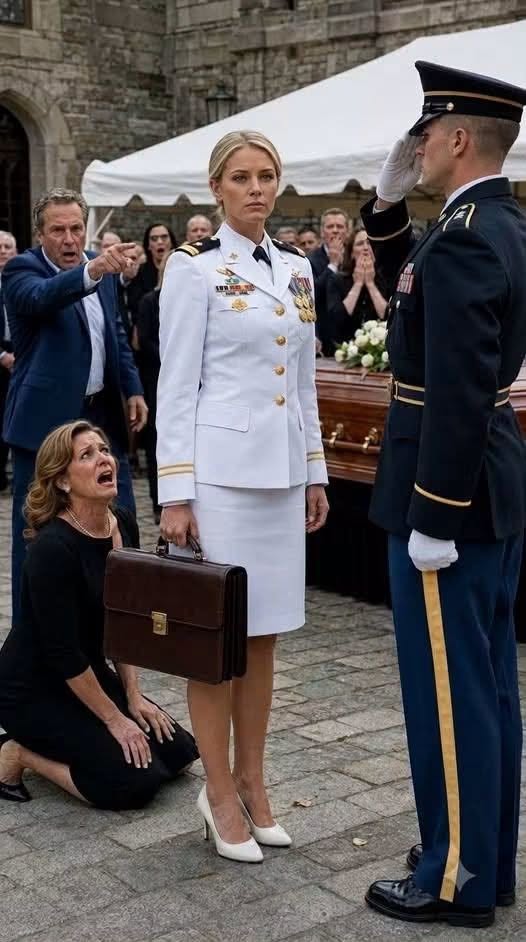
My Wealthy Family Disowned Me for Joining the Army—Then My Grandfather’s Funeral Revealed the Truth
The first words Richard Monroe spoke to me at my grandfather’s funeral were designed to make everyone nearby laugh.
“So,” my father said loudly, “the Army still needs doctors like you?”
He never believed in private cruelty when public humiliation worked better.
We were standing inside the reception hall of a military officers’ club less than an hour after General Arthur Monroe had been laid to rest.
The room was filled with retired generals, defense executives, politicians, lobbyists, senior officers, and people who had spent their entire careers learning how to recognize influence.
I stood before my father in full Army dress uniform, my gloves tucked beneath one arm while the last traces of rain dried across my shoulders.
“Hello, Dad.”
Richard’s eyes moved across my uniform.
The ribbons.
The insignia.
The rank.
He studied them with the same dismissive expression he had worn when I was eighteen.
“Well,” he said, “look who finally decided to come home.”
Then he smirked.
“Should we all line up if we need aspirin?”
A few people laughed.
My younger brother, Caleb, laughed harder than anyone.
That was typical.
Caleb had always known exactly when to follow Dad’s lead.
He lifted his whiskey glass toward me.
“Evie, I didn’t realize Army doctors were allowed off base for family gatherings.”
“They occasionally make exceptions for funerals,” I replied.
His smile tightened.
It wasn’t much.
But after years in environments where small decisions mattered, I had learned not to underestimate small victories.
I looked around the reception hall.
Very little had changed.
Tailored suits.
Crystal glasses.
Quiet conversations beneath expensive chandeliers.
Condolences exchanged beside discussions about contracts, political favors, and future opportunities.
My Monroe family still knew how to turn grief into theater.
My stepmother, Diane, passed close enough to touch my shoulder.
She didn’t acknowledge me.
I reminded myself why I had returned.
Grandfather.
Only Grandfather.
Not Richard.
Not Caleb.
Not Diane.
And certainly not the family that had spent the last decade behaving as though choosing military medicine had made me an embarrassment.
Then the atmosphere in the room shifted.
Conversations near the entrance became quieter.
Several men straightened their jackets.
A senator standing near the bar changed his posture.
People accustomed to power had recognized someone important before I even turned around.
When I did, I saw Thomas Whitmore standing at the entrance.
A senior defense official.
Three security officers remained behind him.
My father noticed him at almost the same moment.
Richard’s smile disappeared.
Whitmore surveyed the room.
His eyes passed over retired generals.
Political donors.
Defense executives.
Then Richard.
Then Caleb.
Finally, he saw me.
And started walking.
Not toward my father.
Toward me.
Toward the daughter Richard Monroe had spent ten years describing as a disappointment.
Whitmore stopped directly in front of me.
Then he saluted.
Training took over instantly.
I returned it.
“Colonel Monroe,” he said. “It’s an honor to see you again.”
Somewhere behind me, I heard the tiny sound of ice shifting inside Caleb’s glass.
Whitmore lowered his voice slightly.
Not enough to make the conversation private.
“The soldiers from that overseas field hospital still talk about you.”
The room seemed to become noticeably quieter.
I could feel my father staring.
When I finally looked toward him, Richard was studying my uniform again.
Only this time, the insignia apparently meant something.
My ribbons had not changed.
My rank had not changed.
I had not changed.
Only his understanding of me had.
Whitmore extended his hand.
I shook it.
“I came to pay my respects to General Monroe,” he said.
Then he paused.
“He spoke about you quite often near the end.”
That hit me harder than anything my father had said all afternoon.
Grandfather and I had barely spoken during the previous decade.
Two cautious phone calls.
Several short messages.
Years of distance.
I had assumed he had chosen the family’s side.
Apparently, I had been wrong.
Whitmore eventually moved away to greet the other guests.
I remained where I was, still trying to understand what he had told me.
Less than two minutes later, my father approached.
He found me near the hallway.
This time there was no audience.
No laughter.
No smug expression.
Just suspicion.
“How do you know Thomas Whitmore?”
For most of my life, Richard could make me feel sixteen years old with a single look.
Like the daughter who desperately wanted his approval and never quite managed to earn it.
But that girl no longer existed.
I was thirty-eight.
A physician.
A colonel.
And I had spent ten years building a life my family had never bothered to understand.
“You meet certain people,” I said quietly, “during the worst days of other people’s lives.”
Richard frowned.
I offered nothing else.
Then I walked away.
Outside, a cold mist drifted across the stone steps.
I had almost reached the lower landing when the doors opened behind me.
Whitmore stepped outside carrying two paper cups.
He offered me one.
“Coffee.”
I accepted it.
“Thank you.”
Then he opened his other hand.
A silver object rested in his palm.
I stopped breathing for a second.
It was my grandfather’s Zippo lighter.
Brushed metal.
Worn around the edges.
A military insignia engraved into one side.
I had watched Grandfather carry it for as long as I could remember.
Whenever he was thinking deeply, he would turn it slowly between his fingers.
Seeing it in Whitmore’s hand felt almost unnatural.
“He wanted you to have this,” Whitmore said.
I reached for it.
Then I noticed something attached underneath.
A thin piece of folded paper.
One word had been written across the front.
Evelyn.
Grandfather’s handwriting.
I recognized it immediately.
My fingers suddenly felt cold.
“How long have you been carrying this?”
“Six weeks.”
I looked up sharply.
“He gave it to me himself,” Whitmore continued. “And he gave me very specific instructions about when I was allowed to give it to you.”
I carefully removed the note.
For ten years, I had believed Grandfather’s silence meant he had abandoned me just like the rest of the family.
But apparently, he had taken something to his final weeks that he never trusted Richard to know.
And now it was sitting in my hands.
I unfolded the paper.
The first line made my heart stop.
“Evelyn, if you are reading this, then you finally came home—and your father still doesn’t know the truth.”
I read it twice.
Then a third time.
Behind me, the reception hall continued humming with quiet conversations.
My father was still inside.
So was the family that had disowned me.
But suddenly, none of them mattered as much as the words in my grandfather’s handwriting.
Because whatever secret he had protected for ten years had survived him.
And he had chosen me—not my father—to receive it.
I looked at Whitmore.
“What truth?”
He shook his head.
“That is for you to discover.”
I looked back down at the letter.
The next sentence began with four words that changed everything:
“Your father lied.”