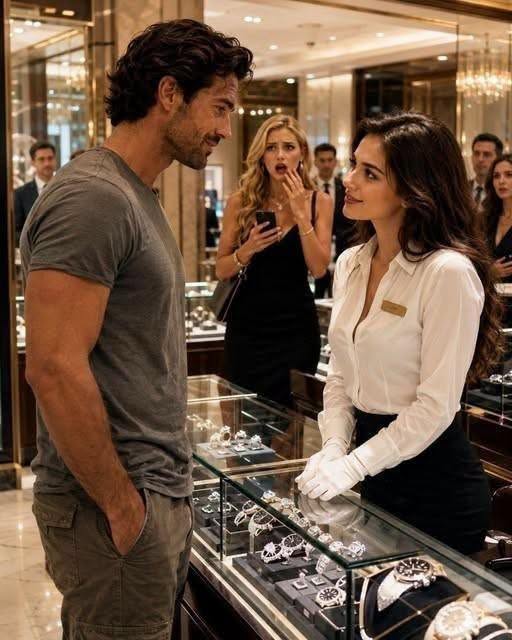
⌚ The Millionaire Owner Walked Into His Own Watch Store Disguised as a Humble Customer—Then One Employee Made Him Regret the Test
Mateo had spent years building his luxury watch business into one of the most prestigious names in Mexico City.
Customers traveled long distances to see the rare pieces in his showroom.
Politicians bought watches there.
Business executives bought watches there.
Celebrities occasionally walked through the doors.
But Mateo had begun to wonder about something more important than sales.
What happened when the wealthy owner wasn’t standing around?
Did his employees treat everyone with respect?
Or did they only show kindness when they knew someone had money?
So one morning, Mateo decided to find out.
He dressed in an old shirt, worn jeans, inexpensive shoes, and a faded jacket.
He left his expensive car several blocks away.
Then he walked into his own store looking like an ordinary man who had wandered in from the street.
The first employee to notice him was Fernanda.
She looked him up and down.
Then she looked at his shoes.
Then his jacket.
Her expression changed.
Mateo smiled politely.
“Good afternoon. I’d like to see some watches.”
Fernanda didn’t even bother hiding her annoyance.
“Those are expensive pieces.”
“I understand.”
She pointed toward one of the displays.
“That watch costs more than your car, if you have one.”
Mateo stared at her for a moment.
Before he could respond, another employee looked up.
Her name was Lucía Ramírez.
She was only twenty years old.
Her hair was neatly tied back, her uniform was perfectly pressed, and there was something remarkably calm about the way she carried herself.
She walked toward him.
“Good afternoon, sir. Welcome.”
Then she smiled.
“Would you like me to show you some models?”
Mateo pointed toward a rose-gold watch with a black leather strap.
“That one looks interesting.”
Fernanda laughed under her breath.
Lucía ignored her.
She put on a pair of white gloves, opened the display case carefully, and removed the watch.
“This is one of our limited pieces,” she explained.
She told him about the movement.
The craftsmanship.
The history behind the design.
The artisans who worked on the piece in Querétaro.
She explained how many had been produced and why collectors valued the model.
For twenty minutes, Lucía treated Mateo as though he were the most important customer in the store.
Not because she believed he was rich.
Not because she expected a commission.
Simply because he was a customer.
And, more importantly, because he was a person.
Mateo listened quietly.
There was no pity in Lucía’s voice.
No exaggerated politeness.
No attempt to impress him.
Just genuine respect.
Finally, Mateo nodded.
“I’ll take it.”
Fernanda’s eyes widened.
“Really?”
Mateo reached into his back pocket.
Nothing.
He checked his front pocket.
Nothing.
Then his jacket.
Still nothing.
He frowned.
“I can’t believe it. I think I lost my wallet.”
For a moment, the store became completely silent.
Then Fernanda burst out laughing.
“I knew it!”
She turned toward Lucía.
“You see? All that effort for nothing.”
Lucía remained composed.
“Fernanda, he’s still a customer.”
“A customer?”
Fernanda rolled her eyes.
“He’s wasting our time.”
Then she looked at Mateo.
“People like you come in here every week pretending they’re going to buy something.”
Lucía’s expression hardened.
But Fernanda wasn’t finished.
“And you defend him because you know what it’s like, right?”
She sneered.
“You come from below too, don’t you?”
The words hung in the air.
Lucía took a slow breath.
Then she answered.
“Yes.”
Fernanda smiled triumphantly.
“My mother sold tamales outside Metro Hidalgo,” Lucía continued. “My father left us with debts instead of a last name.”
Her voice remained steady.
“But I work.”
“I study.”
“And I treat people well.”
She looked down at her uniform.
“You work here too. The difference is that I understand what this uniform is for.”
Fernanda frowned.
“It is for serving.”
“Not humiliating.”
Mateo said nothing.
But something inside him had changed.
He had walked into the store expecting to discover which employees were dishonest.
Instead, he had discovered something much more uncomfortable.
He had discovered how easily people could judge someone based on a jacket, a pair of shoes, or the car they assumed he didn’t own.
That evening, Mateo returned to his enormous home in Lomas de Chapultepec.
He sat at his desk and asked his assistant for Lucía’s employment file.
A few minutes later, a folder appeared in front of him.
Lucía Ramírez.
Age: 20.
Family background: limited.
Mother: deceased.
Father: absent.
Education: university student.
Academic record: outstanding.
Employment record: excellent.
No influential family connections.
No wealthy relatives.
No one who could open doors for her.
Mateo read the file twice.
Then he closed it.
He felt ashamed.
He had wanted to test whether his employees had good hearts.
But he had never stopped to consider what Lucía had already survived.
She hadn’t been handed opportunities.
She had fought for them.
She hadn’t inherited security.
She had built it herself.
And despite everything she had endured, she still found a way to treat strangers with dignity.
Mateo leaned back in his chair.
For the first time, he wondered whether he had been the one who needed to learn something.
The following morning, Lucía arrived for work as usual.
She had no idea what was waiting for her.
Fernanda was already inside.
The moment she saw Lucía walk through the door, a strange smile appeared on her face.
“You’re early,” Fernanda said.
Lucía nodded.
“I like to be on time.”
Fernanda stepped closer.
“You should probably be careful today.”
Lucía frowned.
“Why?”
Fernanda smiled.
“Because yesterday wasn’t the only thing you got wrong.”
Lucía didn’t understand.
Then the showroom doors opened.
Everyone turned.
Mateo walked in.
But this time, he wasn’t wearing the old clothes from the day before.
He was dressed in an impeccably tailored suit.
The employees immediately straightened.
Fernanda’s smile disappeared.
Lucía simply looked at him.
Mateo walked directly toward her.
Then he stopped.
“Good morning, Lucía.”
“Good morning, sir.”
Mateo glanced around the showroom.
Then he said something that made Fernanda’s face lose all color.
“Yesterday, I came here as a customer.”
He paused.
“Today, I’m here as the owner.”
The room went silent.
Fernanda stared at him.
Lucía’s eyes widened.
Mateo continued.
“And I owe someone an apology.”
He turned toward Lucía.
“I came here to test the people who work for me.”
Lucía said nothing.
“I wanted to know how my employees treated someone they believed had no money.”
His expression became serious.
“What I learned was that some people were willing to humiliate a stranger simply because they thought he couldn’t afford anything.”
Fernanda lowered her eyes.
“But I also learned something else.”
Mateo smiled at Lucía.
“Sometimes the person with the least power in the room is the person with the most character.”
Lucía’s eyes filled with tears.
Mateo reached into his pocket.
This time, he pulled out his wallet.
Then he placed the card on the counter.
“I really did intend to buy that watch yesterday.”
A few employees exchanged glances.
“But today, I want to do something different.”
He looked toward Lucía’s file.
“You’re going back to university next semester, correct?”
Lucía nodded slowly.
“Yes.”
“Good.”
Mateo smiled.
“Then your schedule is changing.”
She looked confused.
“You’ll be promoted to senior client adviser.”
Lucía stared at him.
“And the company will cover the remainder of your tuition.”
Her eyes immediately filled with tears.
“I don’t understand.”
“You don’t have to.”
Mateo glanced toward Fernanda.
“Just remember what you told me yesterday.”
Lucía looked at him.
Mateo nodded.
“This uniform is for serving.”
He paused.
“Never for humiliating.”
The showroom became completely quiet.
And Fernanda finally understood the mistake she had made.
She hadn’t humiliated a poor customer.
She had revealed her own character in front of the person who could change her future.
⌚ Sometimes the most valuable thing a person can wear isn’t a luxury watch.
It’s dignity.
And unlike gold or diamonds, dignity has no price tag.