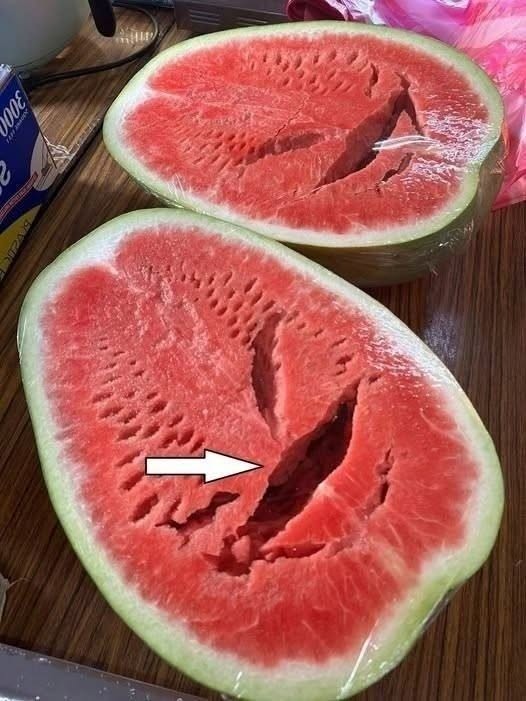
🍉 You Cut Open a Watermelon and Saw Cracks? Don’t Panic—Here’s What They Can Mean!
You slice into a watermelon expecting a juicy, bright-red center… and instead you notice cracks or splits running through the flesh.
Your first thought might be:
“Is this watermelon dangerous to eat?” 😳
Not necessarily.
Cracks inside watermelon can have several causes, and the appearance of the cracks alone isn’t enough to determine whether the fruit is spoiled or unsafe.
🔎 What Causes Cracks Inside a Watermelon?
One possibility is a condition commonly called hollow heart or internal cracking.
These abnormalities can develop while the watermelon is growing, sometimes because of fluctuations in growing conditions, rapid fruit development, or other factors.
The result can be unusual internal spaces, cracks, or a less uniform texture.
Importantly, this isn’t automatically a sign that the watermelon contains something poisonous.
💧 Cracks Don’t Always Mean Rot
A watermelon with internal cracks may still have perfectly normal-looking, edible flesh.
Before deciding what to do, check the fruit carefully.
Ask yourself:
- Does it smell fresh? 👃
- Is the flesh a normal red or pink color? 🍉
- Is the texture reasonably firm?
- Is there any visible mold?
- Is there unusual slime or excessive softness?
- Does it taste fermented, sour, or otherwise abnormal?
If everything looks and smells normal and the watermelon has been stored properly, internal cracking alone doesn’t necessarily mean you need to throw it away.
⚠️ When You Should Throw It Out
Cracks become more concerning when they’re accompanied by obvious signs of spoilage.
🚫 Discard the watermelon if you see mold.
🚫 Don’t eat it if it has a strong rotten, fermented, or unpleasant odor.
🚫 Throw it away if the flesh is slimy, unusually mushy, or discolored in a way that suggests spoilage.
🚫 If the fruit was cut and left unrefrigerated for too long, don’t rely on appearance alone.
When in doubt, it’s safer to discard it.
🦠 What About Bacteria?
The main food-safety concern with cut watermelon isn’t a mysterious “crack toxin.”
It’s microbial contamination and improper storage.
Once a watermelon is cut, its interior is exposed to the environment. Bacteria can multiply if cut fruit is kept at unsafe temperatures for too long.
That’s why cut watermelon should be refrigerated promptly and kept properly chilled.
And always wash the outside of the watermelon before cutting it. A knife can transfer bacteria from the rind into the edible flesh as it passes through.
🔪 What If the Crack Is Deep?
If there’s a deep internal split but the surrounding flesh looks fresh, you can inspect the area carefully.
If you’re uncomfortable with the appearance, simply discard the affected portion—or the whole watermelon if there are multiple signs of deterioration.
There’s no prize for taking a chance with questionable food. 😊
🍉 Don’t Confuse Internal Cracks With an Unsafe Melon
A watermelon can look strange inside and still be edible.
Likewise, a watermelon that looks beautiful on the outside can still become unsafe if it has been improperly handled or stored.
Appearance alone isn’t a guarantee of food safety.
The important clues are freshness, odor, texture, visible spoilage, and proper storage.
🌿 The Bottom Line
Seeing cracks inside a watermelon doesn’t automatically mean you need to stop eating it immediately.
Some internal cracking is a natural quality defect that can occur during growth and doesn’t necessarily make the fruit unsafe.
But if those cracks are accompanied by mold, foul odor, slime, unusual discoloration, or other signs of spoilage, don’t take the risk.
🍉 When a watermelon looks suspicious, trust your senses—and when in doubt, throw it out.
A little caution is far better than a nasty case of food poisoning. 💚