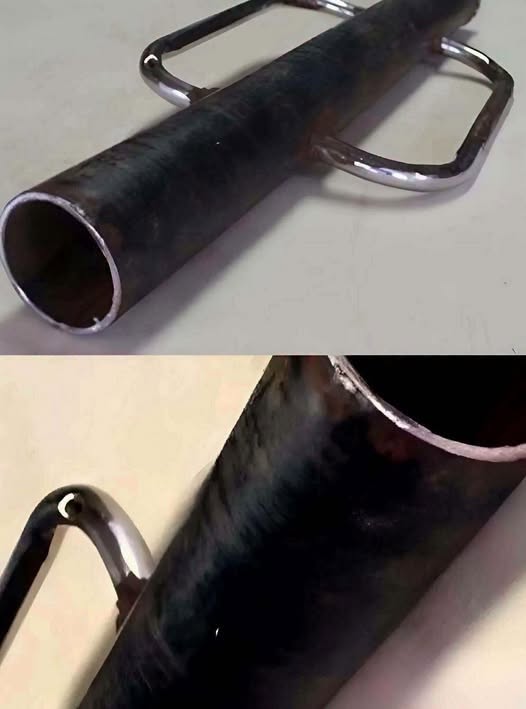
Can You Figure Out What This Mysterious Chunk of Steel Is For?
At first glance, it looks like nothing more than a strange piece of metal.
No obvious buttons. No electronics. No recognizable logo. Just a heavy-looking chunk of steel with an unusual shape.
Yet images of mysterious metal objects like this regularly send the internet into detective mode.
People start guessing immediately.
“It’s a tool.”
“It’s part of an old machine.”
“Maybe it’s something from a factory.”
Others are convinced they’ve seen something similar before—but can’t quite remember where.
So What Is It Really?
That’s what makes these mystery-object puzzles so addictive.
Older tools and mechanical parts were often designed for one very specific purpose. Without seeing the larger machine or knowing the object’s original context, an ordinary piece of steel can look completely meaningless.
The unusual curves, holes, grooves, or flat surfaces may actually have a very practical purpose.
And that’s where the challenge comes in.
Look Closely Before You Guess
Don’t rush to the comments.
Take another look at the object.
Ask yourself:
- Why is it shaped this way?
- What could the holes or grooves be used for?
- Does it look like something designed to grip, hold, cut, support, or align another object?
- Could it be part of a larger machine?
- Does its weight or thickness give you a clue?
Sometimes the smallest detail is the giveaway.
The Fun of Old Tools
One reason these objects are so fascinating is that they remind us how much everyday technology has changed.
A tool that was once completely ordinary to a mechanic, machinist, farmer, or factory worker can become a mystery to later generations.
What looks like a useless piece of steel today may once have been an essential part of someone’s daily work.
Did You Figure It Out?
So, are you really part of the mysterious “1%” who can identify it?
Before checking the answer, make your best guess.
What do you think this strange steel object was designed to do?
Drop your answer in the comments and see how many people came up with the same theory.
And remember: viral claims like “99% of people can’t identify this” are usually part of the fun rather than a scientifically measured statistic.
The real challenge is simply seeing whether YOU can solve the mystery. 👇