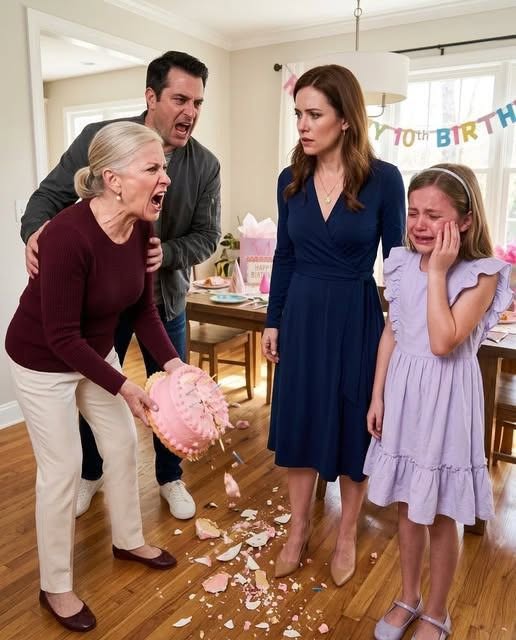
They Said My Daughter Didn’t Deserve a Birthday Celebration
My mother-in-law crossed a line with my daughter on her tenth birthday.
The room went so quiet that every conversation stopped.
Emma froze beside the table, one hand still resting on the edge of her chair.
Her birthday cake—the one she’d spent all morning helping me decorate—was lying upside down on the floor.
Pink frosting covered the carpet.
The candles were scattered across the room.
And my mother-in-law stood over the mess with her arms folded.
“No son, no celebration,” she said coldly.
Emma looked at her father.
Then she looked at me.
“Mom?”
My husband didn’t come to her.
Instead, he nodded toward his mother.
“She’s right.”
For a moment, I couldn’t believe what I’d heard.
This was our daughter’s tenth birthday.
She had been counting down to it for months.
She’d picked the cake flavor herself. She’d chosen the decorations. She’d even made little gift bags for her cousins.
And now the two people who were supposed to make her feel loved were standing there as if she had committed some terrible offense simply by being born a girl.
I wanted to scream.
I wanted to demand an explanation.
But I looked at Emma’s face and realized something more important.
She was watching me.
She needed to know what I was going to do.
So I took a breath.
I didn’t cry.
I didn’t argue.
I simply looked at my husband and his mother and said:
“Okay.”
My mother-in-law smiled.
She thought she’d won.
My husband looked relieved.
He thought I was finally accepting the situation.
Neither of them understood what that one word meant.
Because I wasn’t agreeing with them.
I was finished fighting for a place at their table.
I took Emma’s hand.
“Come on, sweetheart.”
“Where are we going?”
“Home.”
“But my birthday…”
I knelt beside her.
“Your birthday isn’t ruined.”
She looked at the cake on the floor.
“It feels ruined.”
I wiped a tear from her cheek.
“Then we’ll make a new memory.”
We walked out.
Nobody stopped us.
That was the last time I ever celebrated a family occasion in that house.
The next morning, I made a phone call.
Not to my husband.
Not to my mother-in-law.
To a lawyer.
You see, there were things my husband didn’t know.
For years, I’d quietly maintained my own finances. I’d kept records of our accounts, property documents, insurance policies, and every contribution I’d made to our household.
And there was something else.
The house wasn’t entirely his.
My name was on the deed.
The money he’d assumed was available to support his mother’s demands wasn’t simply his to control either.
I wasn’t going to punish anyone.
I wasn’t going to make threats.
I was going to protect my daughter.
Over the next few weeks, I began making changes.
Emma started attending counseling.
I opened an account solely for her future.
I arranged for her birthday celebration to be redone—with the people who actually wanted to celebrate her.
And I started preparing for a life where my daughter’s worth would never again be determined by whether she could give someone a son.
Then came the conversation with my husband.
He expected an apology.
Instead, I handed him a folder.
“What is this?” he asked.
“Our new reality.”
His face went pale as he read the documents.
“You’re leaving?”
“I am.”
“You can’t do this because of one argument.”
I looked him straight in the eyes.
“This wasn’t one argument.”
I reminded him of every time he’d allowed his mother to belittle Emma. Every time he’d dismissed his daughter’s feelings. Every time he’d treated having a boy as though it would somehow make our family complete.
Then I said the sentence I’d been afraid to say for years.
“I’m not raising my daughter in a home where she has to earn the right to feel wanted.”
He had nothing to say.
For once, neither did his mother.
Months later, Emma celebrated her eleventh birthday.
There was cake.
There were balloons.
There were candles.
And when she closed her eyes to make a wish, I knew exactly what I wanted for her.
Not a brother.
Not anyone’s approval.
Not a perfect family.
Just a life where she never doubts that she is enough.
Because sometimes the most powerful response isn’t screaming.
It isn’t revenge.
It isn’t even anger.
Sometimes it’s simply saying:
“Okay.”
And then quietly choosing yourself and your child.