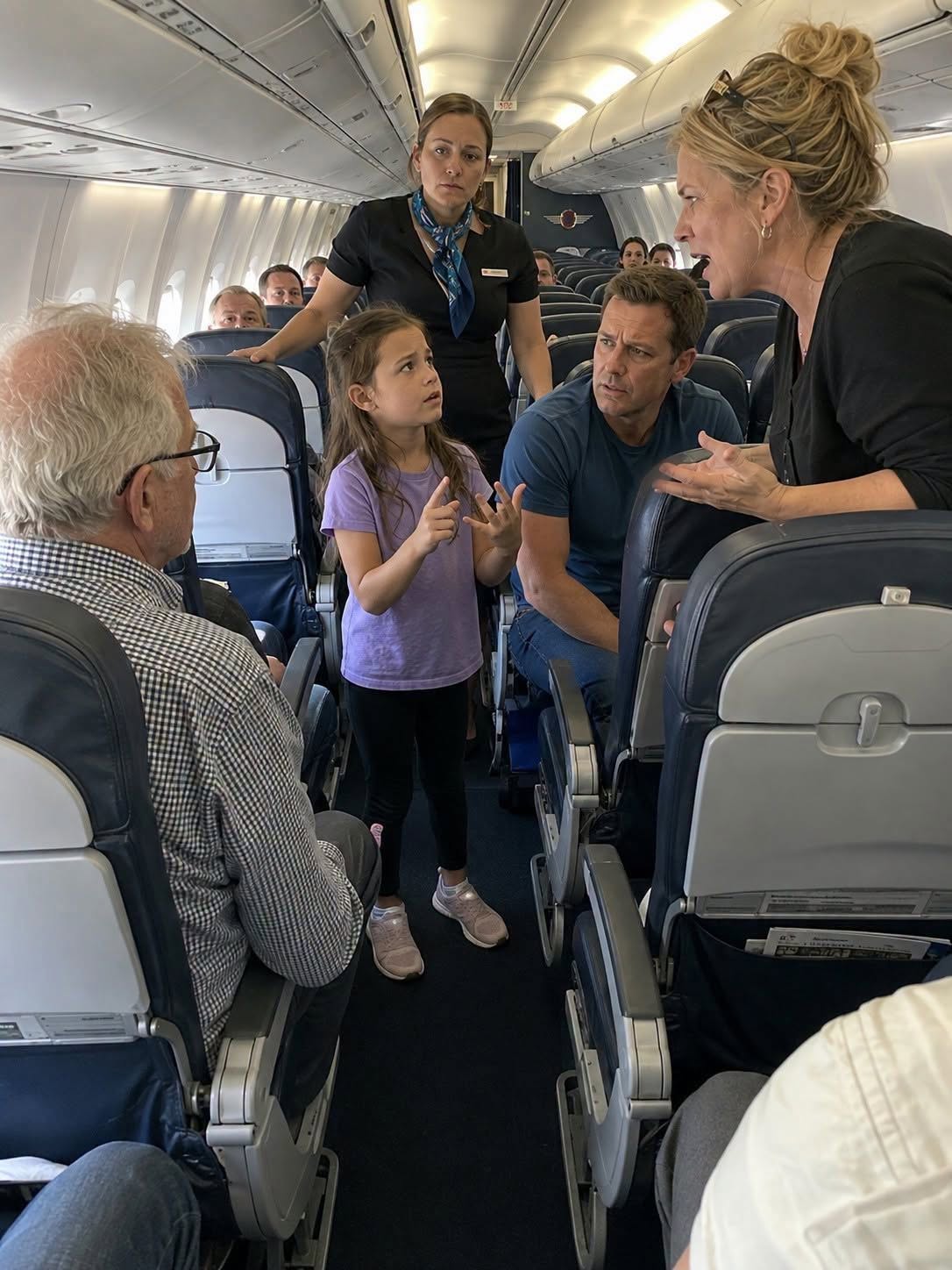
The Little Girl Everyone Misunderstood on the Flight
I watched everything happen from two rows behind.
At first, it seemed harmless.
A little girl, maybe eight years old, was sitting in the middle seat. She politely asked the woman beside her if she could move to the aisle.
She smiled and explained that it would be easier whenever she needed to get up.
The woman let out an exaggerated sigh.
But eventually, she agreed.
I thought that would be the end of it.
I was wrong.
About twenty minutes into the flight, the girl began moving her hands.
At first, I assumed she was playing with something or communicating with someone across the aisle.
The woman beside her clearly became irritated.
“Can you stop waving your hands around like a lunatic?” she snapped.
The girl’s hands immediately stopped.
Her face fell.
I saw her look down at her lap.
Then she slowly started moving her fingers again.
This time, I realized something.
She wasn’t fidgeting.
She was signing.
The little girl was using sign language.
And the woman sitting beside her had just mocked the way she communicated.
I felt my stomach turn.
Before I could say anything, a flight attendant approached.
She crouched beside the girl and gently asked, “Are you okay?”
The girl nodded.
Then she signed something.
The flight attendant looked toward the aisle.
A few seconds later, she smiled.
“Your dad is right up there, isn’t he?”
The girl’s face immediately brightened.
She nodded enthusiastically.
That’s when I understood why she’d been asking to leave her seat.
She wasn’t being restless.
She wasn’t misbehaving.
She kept getting up because her father was sitting several rows ahead.
He was deaf too.
They had been communicating with each other through the aisle using sign language.
The woman beside the girl had mistaken their conversation for disruptive behavior.
But the story wasn’t over.
The flight attendant quietly explained what was happening.
The woman looked embarrassed.
Instead of apologizing, she muttered, “Well, how was I supposed to know?”
The flight attendant didn’t argue.
She simply replied:
“You didn’t have to know. You just had to be kind.”
The cabin became very quiet.
A few passengers exchanged glances.
Then something unexpected happened.
The man sitting across the aisle from the girl’s father turned around.
He had noticed what was happening too.
He signed something to the father.
The father smiled.
Then several other passengers began asking questions.
Some knew sign language.
Some didn’t.
But suddenly, what had started as an uncomfortable confrontation became something completely different.
People were learning.
The little girl wasn’t being difficult.
She wasn’t waving her hands around.
She was talking.
And she was trying to stay connected with her father during a long flight.
Eventually, the woman beside her leaned toward the girl.
“I owe you an apology.”
The girl looked at her.
The woman hesitated.
“I shouldn’t have called you that.”
The little girl nodded.
Then she smiled.
She reached out and showed the woman a simple sign.
The woman looked confused.
The flight attendant explained.
It meant “sorry.”
The woman repeated the gesture.
The girl smiled again.
I watched the whole exchange from my seat and thought about how quickly we judge people when we don’t understand what they’re doing.
A hand movement can look strange when you don’t know the language.
Someone getting out of their seat can look disruptive when you don’t know the reason.
And a child who seems restless might simply be trying to communicate.
We don’t always know what someone else is carrying.
We don’t always know what they’re trying to say.
Sometimes, all we need to do is pause before judging.
Because kindness doesn’t require us to understand everything.
It only requires us to remember that the person in front of us may have a story we haven’t heard yet.