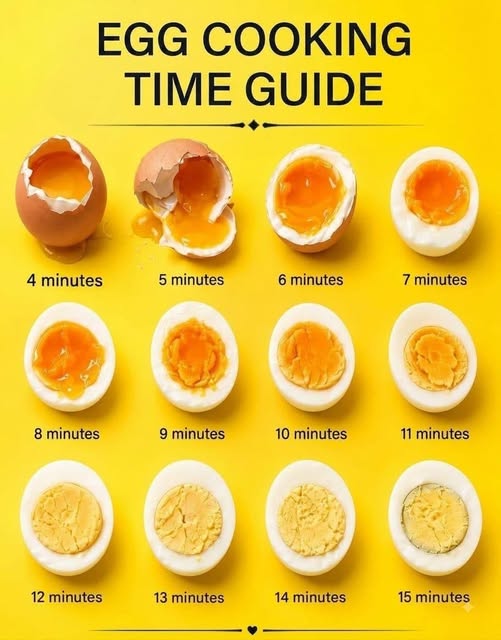
🥚 How Long Should You Cook an Egg to Get It Exactly the Way You Want It?
Whether you love a soft, jammy yolk or prefer your eggs completely firm, a difference of just a few minutes can completely change the result.
The easiest method is to place your eggs into a saucepan, cover them with cold water, bring the water to a boil, then start timing once it reaches a full boil. 🕐
Here’s your simple guide:
🥚 4–5 Minutes — Soft-Boiled
The white is mostly set while the yolk remains beautifully runny.
✨ Perfect for dipping toast or serving over breakfast bowls.
🥚 6–7 Minutes — Jammy Yolk
The white is fully cooked, while the center becomes thick, creamy, and slightly runny.
🍞 This is the sweet spot for ramen, toast, and salads.
🥚 8–9 Minutes — Mostly Set
The yolk is cooked around the edges but may still have a soft, creamy center.
🥗 Great if you want something between a soft-boiled and hard-boiled egg.
🥚 10–12 Minutes — Hard-Boiled
The yolk should be completely firm while the white is fully set.
💪 Ideal for sandwiches, egg salad, snacks, and meal preparation.
❄️ Don’t Forget the Ice Bath!
As soon as your eggs reach your preferred cooking time, transfer them to a bowl of ice water for several minutes.
This quickly stops the cooking process and helps prevent the yolk from becoming overcooked.
It can also make peeling easier.
🌡️ A Few Things Can Change the Timing
Egg size, starting temperature, altitude, and even how vigorously the water is boiling can affect the final result.
If you’re using eggs straight from the refrigerator, the times above are a useful starting point. For the most consistent results, use the same method every time.
🧂 And What About That Gray-Green Ring?
If you’ve ever overcooked an egg and discovered a greenish-gray ring around the yolk, don’t panic. It’s generally caused by a reaction between sulfur in the egg white and iron in the yolk when eggs are cooked for too long or at excessively high temperatures.
The egg may still be safe to eat, but the texture and appearance won’t be as appealing.
🍳 The Perfect Egg Is Really About Timing
4–5 minutes: Runny
6–7 minutes: Jammy
8–9 minutes: Creamy/mostly set
10–12 minutes: Firm
So the next time you’re standing over a pot wondering whether your eggs are ready, don’t guess.
Set a timer. ⏱️🥚
A few minutes can be the difference between a perfectly golden, creamy yolk and a completely firm one.