There’s nothing more disappointing than cutting open a watermelon on a hot summer day, only to
No More Bland Watermelons! A Visual Guide to Finding the Sweetest Fruit at the Market
discover that it’s pale, watery, and nearly flavorless. The good news? You don’t have to rely on luck when choosing your next melon.
With a few simple visual and tactile clues, you can become much better at spotting a ripe, juicy, sweet watermelon before you ever reach the checkout counter.
Here’s your easy guide to picking a watermelon that’s worth bringing home.
1. Look for a Large, Creamy Yellow Field Spot
One of the best clues is the field spot—the discolored patch where the watermelon rested on the ground while growing.
Look underneath the melon for a spot that is creamy yellow, deep yellow, or even orange-yellow. This usually indicates that the watermelon had plenty of time to ripen on the vine.
A watermelon with a very pale green, white, or barely visible field spot may have been harvested before it reached peak maturity.
Visual tip: Don’t be put off by an unattractive yellow patch. That “ugly” spot can actually be a very good sign.
2. Check the Webbing
Those rough, brown, web-like markings on the watermelon may not look particularly pretty, but they can be worth paying attention to.
The webbing develops as the fruit grows and experiences tiny stresses in its skin. In traditional produce-selection wisdom, prominent brown webbing is often associated with a flavorful, well-pollinated melon.
It isn’t a guarantee of sweetness, but when combined with other signs, it can help you narrow down your choices.
3. Choose a Dull, Not Shiny, Rind
A watermelon that looks glossy and bright may be tempting, but a duller, slightly matte rind can be a better sign of maturity.
As watermelons ripen, their outer appearance generally becomes less shiny. Look for a melon with a relatively uniform rind and a mature, slightly muted appearance.
Think of it this way: when you’re choosing between two otherwise similar watermelons, the less glossy one may be worth a closer look.
4. Go for the Heaviest One for Its Size
This is where your hands become your secret weapon.
Pick up two watermelons that appear to be roughly the same size. Choose the one that feels heavier.
A heavier melon for its size generally contains more water, which is exactly what you want from a juicy watermelon.
You don’t need to know the precise weight. Simply compare similar-sized melons and look for the one that feels surprisingly substantial.
5. Look for a Uniform, Well-Formed Shape
Round or oval? Either can be delicious.
What matters more is that the watermelon has a consistent, symmetrical shape without obvious dents, irregular bumps, or deep indentations.
A uniformly shaped melon may have developed more evenly, while large irregularities can sometimes indicate inconsistent growing conditions.
Don’t reject a melon simply because it isn’t perfectly round. Shape varies naturally between varieties.
6. Don’t Be Afraid of Brown Spots
Not every mark on a watermelon is a problem.
Small, dry-looking brown marks or rough patches can occur naturally as the fruit grows. They aren’t necessarily signs that the watermelon is spoiled.
However, avoid melons with soft, sunken, leaking, moldy, or badly damaged areas. Those are much more concerning than ordinary surface blemishes.
The goal isn’t to find the prettiest watermelon. It’s to find one that looks mature and healthy.
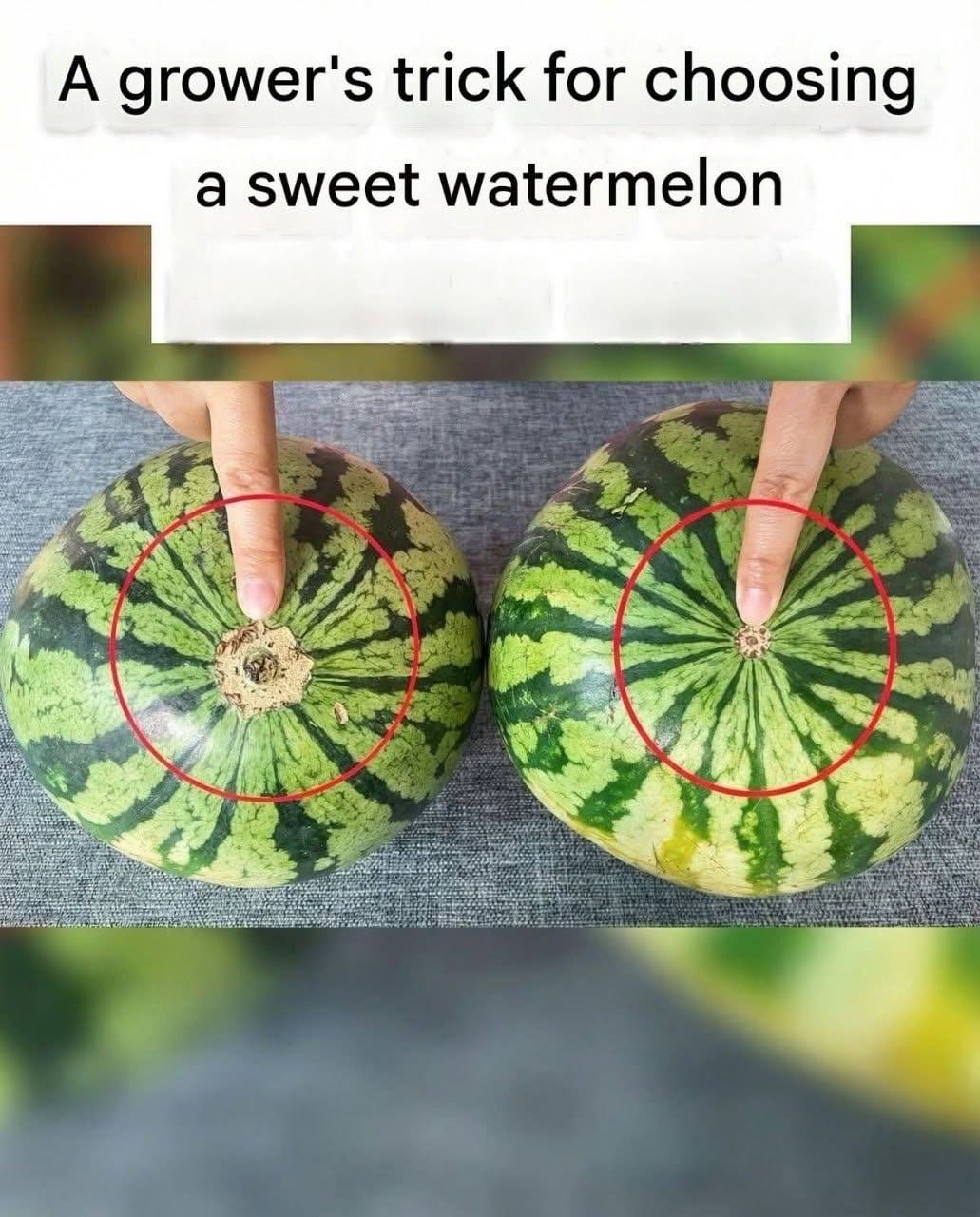
7. Check the Stem End
If the watermelon still has part of its stem attached, take a look at it.
A dry, brownish stem can indicate that the fruit had time to mature before being harvested. A very green stem may suggest that it was picked relatively early.
This isn’t a foolproof test—many supermarket watermelons have little or no stem remaining—but when available, it’s another clue you can use.
8. Give It a Gentle Knock
You’ve probably seen people tapping watermelons at the market. There’s some useful information in doing so, although it shouldn’t be your only test.
Give the melon a gentle tap and listen.
A deep, relatively resonant sound is traditionally considered a positive sign, while a dull or flat sound may indicate a less desirable melon.
The problem is that sound can be difficult to interpret, especially if you haven’t compared lots of watermelons.
So use the tapping trick as a bonus clue—not the deciding factor.
9. Don’t Assume Bigger Means Sweeter
A giant watermelon isn’t automatically a sweeter watermelon.
Size depends heavily on the variety and growing conditions. Instead of chasing the biggest melon in the display, prioritize maturity, weight for size, a good field spot, and an overall healthy appearance.
Sometimes the medium-sized watermelon is the one that delivers the best flavor.
10. Look at the Whole Picture
The secret to choosing a great watermelon isn’t finding one magical visual indicator.
Instead, combine several clues:
- A creamy yellow or orange-yellow field spot
- A heavy feel for its size
- A relatively dull, mature-looking rind
- A symmetrical shape
- Some natural webbing or markings
- No soft, rotten, moldy, or severely damaged areas
- A dry stem, if one is present
The more of these signs you find together, the more promising your watermelon is likely to be.
What About the Sugar Spot?
You may hear shoppers talk about “sugar spots”—brown or dark markings that supposedly prove a watermelon is exceptionally sweet.
These markings can be associated with natural growth and surface changes, but they aren’t a guaranteed sweetness test. Don’t automatically reject a melon because it lacks them, and don’t buy one solely because it has them.
Your best approach is to consider several characteristics rather than trusting a single trick.
What You Can’t Reliably Tell From the Outside
Even experienced shoppers can’t guarantee sweetness simply by looking at a whole watermelon.
Factors such as variety, growing conditions, maturity at harvest, and storage all influence the final flavor. External signs can improve your odds, but they aren’t a perfect prediction of what’s inside.
That’s why the best strategy is to stack the evidence in your favor.
The 30-Second Watermelon Test
Next time you’re standing in front of a pile of watermelons, don’t overthink it.
Take a few seconds to:
Look: Find a large creamy-yellow field spot and a mature-looking, relatively dull rind.
Lift: Compare similarly sized melons and choose one that feels heavy.
Inspect: Look for a symmetrical shape and avoid soft, damaged, or moldy areas.
Check: If there is a stem, look for one that appears dry rather than bright green.
Tap: Give it a gentle knock and use the sound as one final clue.
Then take your winner home and chill it before slicing.
The Bottom Line
Choosing a sweet watermelon doesn’t have to be a guessing game.
The next time you’re at the market, skip the impulse pick and look for the clues: a substantial weight, a creamy yellow field spot, a mature-looking rind, a healthy shape, and no signs of damage.
No single trick can promise a perfectly sweet watermelon every time, but combining these signs can greatly improve your chances of bringing home a juicy, refreshing fruit.
And when you finally cut it open and find that deep, crisp, sweet red flesh?
That’s when you’ll know your watermelon-picking skills have officially leveled up.