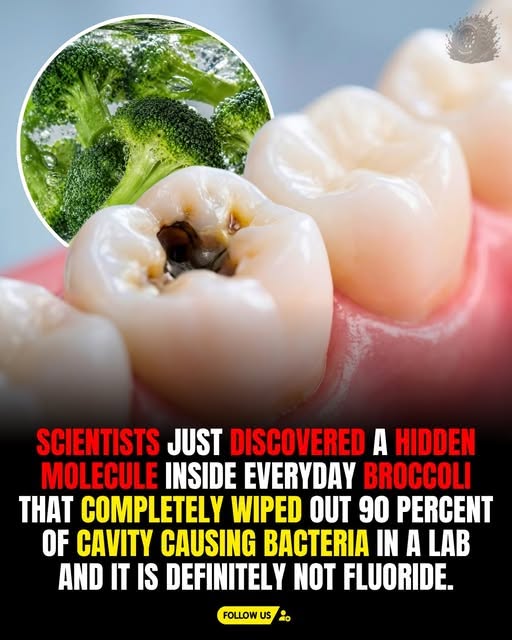
🥦🦷 Scientists Found a Surprising Compound in Broccoli and Cabbage That Could Help Fight Cavity-Causing Bacteria
Broccoli, cabbage, and Brussels sprouts may not be everyone’s favorite vegetables.
But hiding inside these ordinary foods are some remarkably interesting plant compounds—and researchers are discovering that they may interact with harmful bacteria in unexpected ways. 🥦✨
One compound in particular has caught scientists’ attention:
3,3′-diindolylmethane, or DIM.
DIM is produced when the body breaks down certain compounds naturally found in cruciferous vegetables such as broccoli, cabbage, and Brussels sprouts.
🦷 A Potential Enemy of Dental Plaque
Researchers associated with Ben-Gurion University of the Negev have investigated DIM’s ability to interfere with bacterial biofilms.
Biofilms are the sticky communities of microorganisms that can form on surfaces—including our teeth.
One important culprit behind tooth decay is Streptococcus mutans, a bacterium that contributes to plaque formation and produces acids that can damage tooth enamel.
In laboratory experiments, DIM showed an ability to disrupt the biofilm produced by this bacterium. Reports on the research describe reductions of around 92% in the bacterial biofilm under laboratory conditions.
That’s an intriguing result.
But there’s an important distinction.
🔬 Promising Doesn’t Mean Proven
The experiments were conducted under controlled laboratory conditions.
That does not mean that eating a serving of broccoli will eliminate 92% of the bacteria in your mouth—or that broccoli can replace brushing, flossing, fluoride toothpaste, or professional dental care.
Scientists still need to determine how these compounds behave in the much more complicated environment of the human mouth and whether they can eventually be developed into practical dental treatments.
In other words:
This is an interesting scientific lead, not a miracle cure. 🧪
🌱 Cruciferous Vegetables Are Chemical Powerhouses
DIM isn’t the only interesting compound associated with these vegetables.
Cruciferous vegetables contain a variety of glucosinolates and other phytochemicals. Compounds derived from them—including sulforaphane and indole-related molecules—have been the subject of extensive research into their biological effects.
That’s one reason broccoli, cabbage, Brussels sprouts, cauliflower, and related vegetables have attracted so much attention from nutrition researchers.
They may look ordinary on the outside.
Chemically, they’re anything but ordinary.
🥦 Your Dinner Plate Could Be a Research Laboratory
The fascinating part of this research is that scientists aren’t necessarily looking for exotic substances in remote places.
Sometimes, potentially useful molecules are hiding in foods people have been eating for generations.
A humble head of broccoli contains a complex collection of natural chemicals that plants use for their own biology—and some of those compounds may interact with human cells and microorganisms in surprising ways.
Researchers are now asking whether those natural molecules could eventually inspire new approaches to problems such as bacterial biofilms and antibiotic resistance.
🧪 The Bigger Picture
The discovery doesn’t mean broccoli is about to replace the dentist.
But it does highlight something scientists have known for a long time:
Nature can be an extraordinary source of chemical clues.
A vegetable sitting in your refrigerator may contain molecules that researchers are still learning how to understand.
And perhaps that’s the most exciting part.
The next breakthrough in medicine doesn’t always begin with a complicated machine or a synthetic drug.
Sometimes, it begins with something as ordinary as a piece of broccoli. 🥦🔬✨