🌫️💧 In One of the Driest Places on Earth, Giant Nets Are Turning Fog Into Fresh Water
Imagine standing in one of the driest landscapes on Earth.
Rain is almost nonexistent. The ground is covered in rock and sand. Yet every morning, a thick blanket of fog rolls in from the Pacific Ocean.
Instead of waiting for rain, researchers in Chile have found a remarkable way to capture the water already floating through the air. 🌫️💧
🕸️ The Giant Nets That Harvest Fog
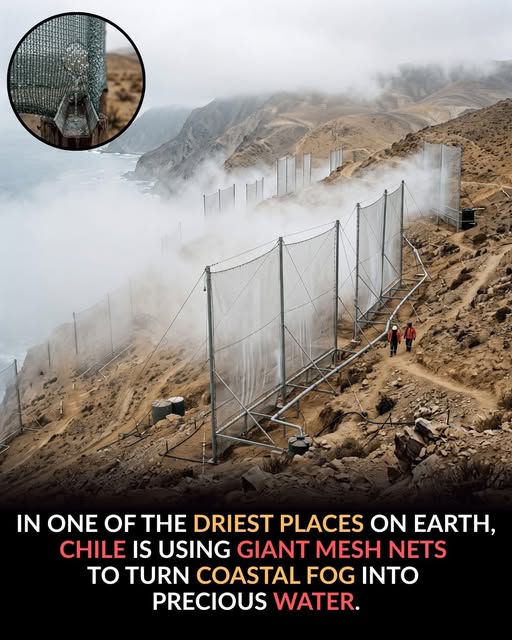
Along Chile’s arid northern coast, researchers use structures known as fog catchers.
They look surprisingly simple: large mesh screens positioned where the coastal fog, known locally as camanchaca, regularly moves across the landscape.
As the fog passes through the mesh, tiny droplets of water collide with the fibers and gather together.
Gravity does the rest.
The droplets run down the mesh into gutters, flow through channels, and are collected in storage containers.
No pumps are needed to pull the water from the air.
The fog itself provides the source, while the mesh simply gives those microscopic droplets a surface on which to collect.
💧 Hundreds of Liters From the Air
At UC Chile’s Atacama Station in Alto Patache, fog collectors have demonstrated impressive yields.
UC Chile reports that collectors there can average around 224 liters of water per day, while other measurements at the station have reached higher amounts depending on the equipment and conditions.
That is remarkable when you consider the environment.
The surrounding region receives almost no rainfall, yet the coastal fog can arrive regularly enough to become a meaningful source of water.
It’s essentially nature delivering tiny droplets on the wind—and scientists have learned how to catch them.
🌵 A Desert That Depends on Fog
The camanchaca isn’t merely useful to people.
It is also critically important to the ecosystems of northern Chile.
In places such as Alto Patache, plants and other organisms have adapted to obtain moisture from fog. Researchers describe these areas as fog oases, where atmospheric water helps sustain life in an otherwise extremely dry environment.
That makes fog harvesting more than an engineering curiosity.
It is an example of working with an existing natural process rather than trying to force an entirely new one.
🌱 Could Fog Help Communities Facing Water Shortages?
Researchers and communities are already exploring practical applications.
Recent projects in Chile have used fog catchers to support irrigation, ecological restoration, and water supplies for people and animals. One community project in the Cerro Grande Ecological Reserve has 34 collectors covering 306 square meters and has reported the potential to capture up to 650,000 liters of water per year.
Chile has also developed a public Fog Water Map showing where along roughly 2,000 kilometers of coastline fog water could potentially be collected and how much might be available.
That could help researchers and communities determine where this unusual water source is most practical.
🌍 A Simple Idea With a Powerful Message
There is something almost magical about the concept.
In a place where rain barely falls, water is arriving every day—hidden inside the fog.
The challenge was simply learning how to collect it.
Fog catchers won’t solve every water shortage, and their performance depends heavily on local fog, wind, location, and collector design. But they demonstrate an important principle:
Sometimes the resources we need aren’t absent. They’re simply hiding in forms we haven’t learned to use yet.
In Chile’s Atacama Desert, scientists aren’t making it rain.
They’re doing something perhaps even more fascinating.
They’re catching the clouds. 🌫️💧🌵