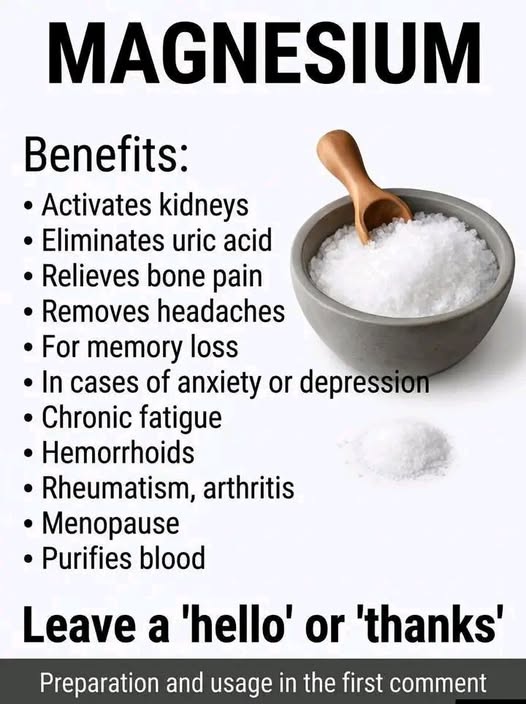
Chinese doctors—whether practicing Traditional Chinese Medicine (TCM) or modern Western-integrated medicine—often recommend magnesium because its biochemical functions perfectly “map” onto core principles of Chinese health.
In the world of TCM, magnesium is effectively treated as a mineral that anchors energy and smooths out the flow of $Qi$. Here is why they prioritize it:
1. It “Anchors” the Shen (Mind & Spirit)
In TCM, the Heart is said to house the Shen, which represents your consciousness and emotional balance. When you are stressed, anxious, or unable to sleep, it’s seen as the Shen being “unsettled.”
-
The Magnesium Connection: Magnesium is a natural NMDA receptor antagonist and a GABA agonist. It literally calms the nervous system.
-
Recommendation: Doctors suggest it for patients with Heart Yin deficiency—those who feel “tired but wired,” suffer from palpitations, or have racing thoughts at night.
2. It “Nourishes the Sinews” (Muscle & Liver Health)
The Liver in TCM is responsible for the health of the “sinews” (tendons and muscles) and the smooth flow of $Qi$. If the Liver $Qi$ is stagnant or Blood is deficient, you get cramps, spasms, and irritability.
-
The Magnesium Connection: Magnesium is the primary mineral responsible for muscle relaxation. It counteracts calcium (which causes contraction).
-
Recommendation: It is frequently prescribed for PMS cramping, restless leg syndrome, and “Liver Fire” symptoms like tension headaches and jaw clenching.
3. It Supports “Spleen Qi” (Digestion & Energy)
The Spleen is the “engine” of the body in TCM, turning food into energy ($Qi$). Fatigue and constipation are often signs of Spleen $Qi$ deficiency.
-
The Magnesium Connection: Magnesium is a co-factor in over 300 enzymatic reactions, most notably the production of ATP (the body’s energy currency) and maintaining bowel motility.
-
Recommendation: For patients with slow digestion or chronic fatigue, magnesium is viewed as a “spark plug” to help the Spleen function more efficiently.
Comparison of Magnesium Types in a Clinical Context
Chinese doctors often choose the type of magnesium based on the patient’s specific TCM pattern:
| Magnesium Form | TCM Pattern Focus | Primary Benefit |
| Glycinate | Heart/Shen Disturbance | Best for sleep, anxiety, and deep relaxation. |
| Malate | Spleen Qi Deficiency | Best for chronic fatigue and muscle pain. |
| Citrate | Stagnation / Excess Heat | Best for constipation and “clearing” the gut. |
| Taurate | Heart Qi/Yang Issues | Best for blood pressure and heart rhythm. |